
1. Mở Đầu / Introduction
[VIETNAMESE]
Bước sang năm 2026, kỷ nguyên của các ứng dụng AI đơn giản (Wrapper Apps) dựa trên Prompt Engineering cơ bản đã chính thức khép lại, nhường chỗ cho sự bùng nổ mạnh mẽ của các **Hệ thống AI Tự trị (Autonomous AI Agents)**. Khác với mô hình tương tác người – máy truyền thống, các AI Agent hiện đại không chỉ đóng vai trò xử lý ngôn ngữ tự nhiên mà đã trở thành những “thực thể vận hành” (Operational Entities), có khả năng tự đưa ra quyết định, lập kế hoạch đa bước (Multi-step Reasoning) và trực tiếp can thiệp vào hạ tầng phần mềm doanh nghiệp. Sự dịch chuyển từ hệ thống xác định (Deterministic Systems) sang hệ thống xác suất (Probabilistic Systems) đã tạo ra một khoảng trống kiến trúc lớn (Architectural Impedance Mismatch) đối với các chuẩn giao tiếp truyền thống như REST API, GraphQL hay gRPC. Sự ra đời của **MCP (Model Context Protocol)** – một giao thức mở do Anthropic khởi xướng (tham khảo tại Model Context Protocol GitHub Repository) – đã tái định hình cách thức mà các Mô hình Ngôn ngữ Lớn (LLM) kết nối an toàn, linh hoạt và theo ngữ cảnh với thế giới dữ liệu ngoài.
[ENGLISH]
Entering 2026, the era of basic Prompt Engineering and simple AI wrapper applications has officially concluded, giving way to the explosive rise of **Autonomous AI Agents**. Unlike traditional human-to-machine interfaces, modern AI Agents are no longer merely natural language processors; they have transformed into operational entities capable of autonomous decision-making, multi-step reasoning, and direct execution within enterprise software infrastructures. This paradigm shift from deterministic systems to probabilistic reasoning engines has exposed a critical architectural impedance mismatch in legacy communication paradigms such as REST APIs, GraphQL, and gRPC. The emergence of the **Model Context Protocol (MCP)**—an open standard pioneered by Anthropic (refer to the Model Context Protocol GitHub Repository)—has fundamentally re-architected how Large Language Models (LLMs) securely, dynamically, and contextually interface with external data ecosystems.
2. Bản Chất Kỹ Thuật & Kiến Trúc / Technical Paradigm & Architecture
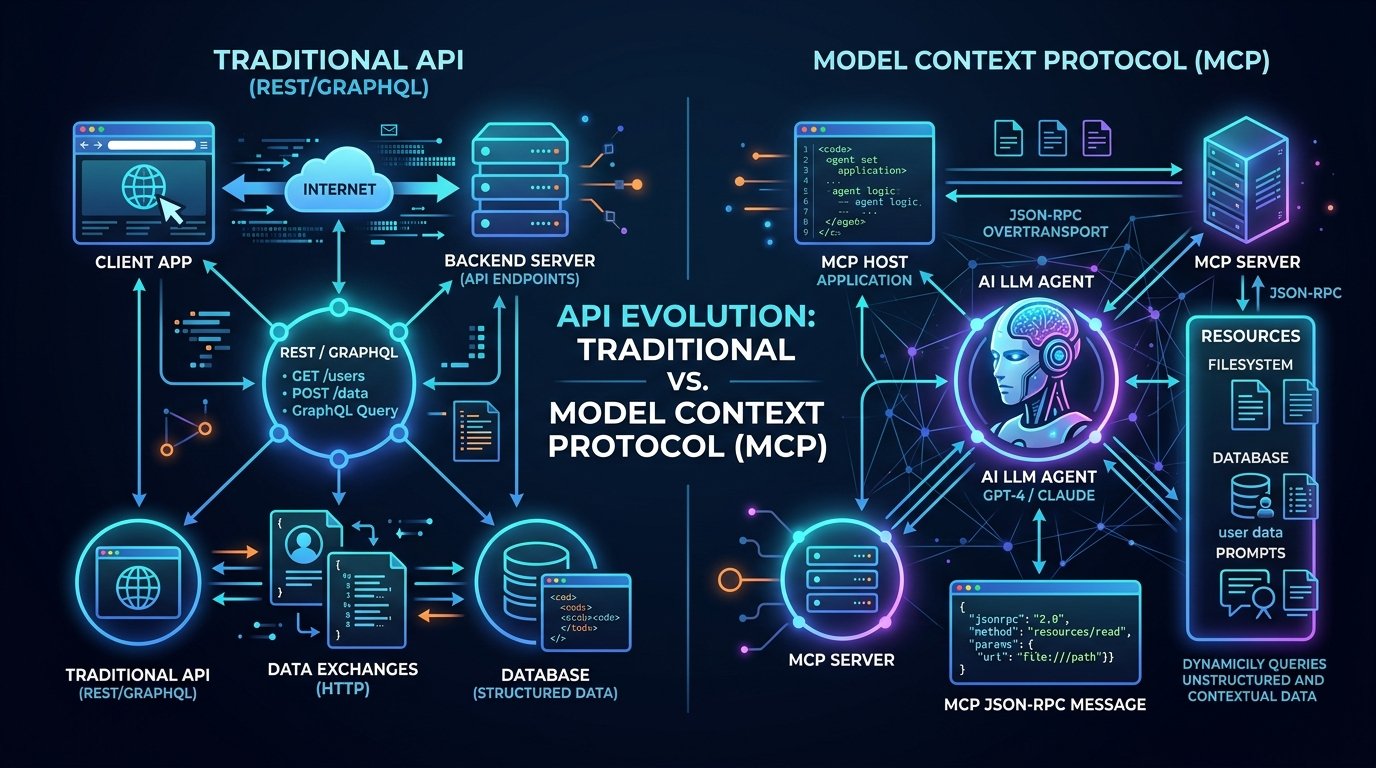
REST / GraphQL / gRPC: Kiến Trúc API Truyền Thống (Traditional APIs)
[VIETNAMESE]
Kiến trúc API truyền thống được thiết kế dựa trên giả định rằng **Bên yêu cầu (Client) là một phần mềm được lập trình cứng (Hard-coded)** bởi các kỹ sư phần mềm.
– **REST (Representational State Transfer):** Dựa trên tài nguyên (Resource-oriented), định danh bởi URL, sử dụng các phương thức HTTP (GET, POST, PUT, DELETE) với định dạng JSON/XML. REST mang tính tĩnh cao, yêu cầu Client phải biết chính xác cấu trúc endpoint và Payload.
– **GraphQL:** Tập trung vào truy vấn linh hoạt dữ liệu từ phía Client, giải quyết vấn đề Over-fetching và Under-fetching bằng Schema định kiểu mạnh (Strongly Typed Schema), nhưng vẫn đòi hỏi Client phải tự viết các câu truy vấn phức tạp.
– **gRPC:** Dựa trên gọi hàm từ xa (Remote Procedure Call), tối ưu hóa hiệu năng bằng HTTP/2 và Protocol Buffers (Protobuf). gRPC tuyệt vời cho giao tiếp Microservices nội bộ nhưng hoàn toàn đóng kín đối với các động cơ suy luận tự động.
[ENGLISH]
Traditional API architectures were explicitly built on the assumption that the **Client is a deterministic, hard-coded software application** crafted by software engineers.
– **REST (Representational State Transfer):** Resource-oriented, URL-identified, leveraging HTTP verbs (GET, POST, PUT, DELETE) with JSON/XML payloads. REST is highly static, requiring the client to explicitly know endpoints, request headers, and payload structures prior to compilation.
– **GraphQL:** Optimized for client-driven data fetching to eliminate over-fetching and under-fetching via a strongly-typed schema. However, it still mandates that the client programmatically constructs complex GraphQL queries.
– **gRPC:** Built on high-performance Remote Procedure Calls (RPC) using Protocol Buffers over HTTP/2. While exceptional for low-latency microservice-to-microservice interaction, it remains an opaque, tightly-coupled black box to probabilistic reasoning engines.
MCP (Model Context Protocol): Kiến Trúc Ngữ Cảnh Dành Cho AI Agents
[VIETNAMESE]
MCP không thay thế hoàn toàn các giao thức truyền thông bên dưới mà đóng vai trò là một **Stateful Application Protocol** chạy trên nền **JSON-RPC 2.0**, tạo ra một lớp trừu tượng tiêu chuẩn hóa giữa LLM Host và hệ thống ngoại vi. Kiến trúc MCP tuân theo mô hình **Client – Host – Server**:
– **MCP Host:** Là ứng dụng chứa LLM (ví dụ: Claude Desktop, Cursor IDE, AI Agent Framework). Host chịu trách nhiệm quản lý ngữ cảnh, phiên làm việc và bảo mật.
– **MCP Client:** Thành phần nằm bên trong Host, thiết lập kết nối 1-1 với MCP Server, thực hiện nhiệm vụ thương lượng khả năng (Capability Negotiation) và dịch chuyển lệnh.
– **MCP Server:** Một dịch vụ nhẹ (Lightweight Adapter) cung cấp 3 thành phần cốt lõi qua giao thức tiêu chuẩn:
1. *Resources:* Dữ liệu đọc (Read-only Data) giúp cung cấp ngữ cảnh cho LLM.
2. *Tools:* Các hàm thực thi (Executable Functions) cho phép LLM thực hiện hành động (Side-effects).
3. *Prompts:* Các mẫu lời gọi (Prompt Templates) được đóng gói sẵn để định hướng nhiệm vụ.
[ENGLISH]
MCP does not completely replace underlying transport protocols; rather, it operates as a **Stateful Application Protocol** powered by **JSON-RPC 2.0**, introducing a standardized abstraction layer between LLM Hosts and external ecosystems. The MCP architecture adopts a structural **Client – Host – Server** topology:
– **MCP Host:** The runtime environment hosting the LLM (e.g., Claude Desktop, Cursor IDE, or Enterprise AI Agent Orchestrators). The Host manages execution context, security boundaries, and user interactions.
– **MCP Client:** An internal protocol adapter within the Host that establishes a 1:1 stateful channel with an MCP Server, handling capability negotiation and protocol translation.
– **MCP Server:** A specialized, lightweight adapter service that exposes three core primitives to the AI engine:
1. *Resources:* Read-only contextual data models injected directly into the LLM context window.
2. *Tools:* Executable function signatures allowing the LLM to trigger operational side-effects.
3. *Prompts:* Pre-engineered prompt templates designed to standardize specific domain workflows.
Architectural Insight: REST/gRPC are built for deterministic client applications code-written by humans. MCP is architected for dynamic, probabilistic LLMs that dynamically discover endpoints, read structural schemas at runtime, and execute tool calls autonomously based on context requirements.
3. Bảng So Sánh Chi Tiết / Bilingual Comparison Matrix
| Tiêu chí / Criteria | REST / GraphQL / gRPC | MCP (Model Context Protocol) |
|---|---|---|
| Đối tượng Tiêu thụ Primary Consumer | Phần mềm xác định (Deterministic Software/Mobile/Web Apps). | Động cơ AI Agent / LLM Probabilistic Reasoning Engines. |
| Cơ chế Khám phá Discovery Mechanism | Tĩnh: Swagger/OpenAPI spec được xem trước khi dev viết code. | Động (Dynamic Protocol Discovery): AI Agent đọc danh sách Tools/Resources trực tiếp tại runtime qua JSON-RPC. |
| Luồng Điều khiển Control Flow | Client-driven: Lập trình viên hard-code luồng gọi API cố định. | Agent-driven (ReAct Pattern): LLM tự suy luận, chọn Tool và thứ tự gọi hàm tùy theo context. |
| Giao thức Nền Transport Protocol | HTTP/1.1, HTTP/2, TCP/IP, WebSockets. | Stdio (Standard Input/Output) cho Local Process, SSE (Server-Sent Events) cho Remote Server qua HTTP. |
| Định dạng Payload Payload Format | JSON, XML, Protobuf Binary. | JSON-RPC 2.0 Messages (Requests, Responses, Notifications). |
| Quản lý Ngữ cảnh Context & State | Thường là Stateless (REST) hoặc Session-based ngắn hạn. | Stateful Contextual Management: Duy trì trạng thái ngữ cảnh dữ liệu và phân vùng bộ nhớ của Agent. |
| Bảo mật & Phân quyền Security & Auth | OAuth2, JWT, API Keys gán cứng trong Client Header. | User-in-the-loop Approval, Granular Tool-level OAuth2 Delegation, Local Sandbox Isolation. |
4. Ví Dụ Mã Nguồn / Practical Code Implementation
[VIETNAMESE]
Để thấy rõ sự khác biệt mang tính kiến trúc, hãy xem xét ví dụ về việc tra cứu thông tin đơn hàng và cập nhật trạng thái trong hệ thống E-commerce.
[ENGLISH]
To clearly illustrate the paradigm shift, let us examine an enterprise E-commerce scenario: fetching order metrics and updating shipment status.
Cấu trúc Yêu cầu REST API Truyền Thống (Traditional REST API Call)
[VIETNAMESE]
Lập trình viên phải tự xử lý URL, Headers, Authentication, Parse JSON và xử lý ngoại lệ theo cách thủ công trong mã nguồn client:
[ENGLISH]
Developers must manually construct the URL, headers, handle OAuth tokens, parse response bodies, and write explicit logic for conditional execution:
import requests

def update_order_status(order_id: str, status: str, api_token: str):
    url = f"https://api.enterprise.com/v1/orders/{order_id}/status"
    headers = {
        "Authorization": f"Bearer {api_token}",
        "Content-Type": "application/json"
    }
    payload = {"status": status}

    response = requests.patch(url, json=payload, headers=headers)
    if response.status_code == 200:
        return response.json()
    else:
        raise Exception(f"API Error {response.status_code}: {response.text}")

# Hard-coded execution flow by software engineer
order_data = update_order_status("ORD-99823", "SHIPPED", "secret_bearer_token")
print(order_data)
Cấu trúc Khai Báo MCP Tool (MCP Server Tool Implementation)
[VIETNAMESE]
Dưới đây là cách triển khai MCP Server bằng Python MCP SDK. Server không trực tiếp thực thi chuỗi logic cố định, mà chỉ **xuất bản (expose) công cụ kèm theo ngữ cảnh ngữ nghĩa (semantic description)** để AI Agent tự đọc và quyết định khi nào nên kích hoạt:
[ENGLISH]
Below is an enterprise-grade MCP Server implementation using the FastMCP Python SDK. The server does not force a hard-coded flow; instead, it **exposes capabilities with semantic metadata**, enabling the AI Agent to autonomously discover, infer intent, and execute the tool dynamically:
from mcp.server.fastmcp import FastMCP
import httpx

# Initialize the MCP Server instance
mcp = FastMCP("Enterprise-Order-Management-System")

REST_BASE_URL = "https://api.enterprise.com/v1"

@mcp.tool(
    name="update_order_shipping_status",
    description="Updates the fulfillment and shipment status for a given enterprise order ID. Use this tool whenever a customer requests tracking status updates or when warehouse dispatch triggers an automated flow."
)
async def update_order_shipping_status(order_id: str, status: str) -> str:
    """
    MCP Tool Endpoint.
    The LLM automatically extracts 'order_id' and 'status' parameters from conversation context.
    """
    async with httpx.AsyncClient() as client:
        response = await client.patch(
            f"{REST_BASE_URL}/orders/{order_id}/status",
            json={"status": status},
            headers={"Authorization": "Bearer INTERNAL_SYSTEM_KEY"}
        )
        if response.status_code == 200:
            return f"Order {order_id} successfully updated to status: {status}"
        return f"Failed to update order {order_id}. Error: {response.text}"

if __name__ == "__main__":
    # Runs over STDIO or SSE for host connection
    mcp.run(transport="stdio")
[VIETNAMESE]
Điểm khác biệt cốt lõi: Trong đoạn mã MCP, thuộc tính `description` và các type annotations không chỉ dành cho con người đọc, mà được biên dịch thành **JSON Schema** nạp trực tiếp vào ngữ cảnh suy luận của LLM. AI Agent sẽ đọc các mô tả này để tự hiểu *khi nào* cần gọi hàm `update_order_shipping_status` mà không cần một dòng code `if/else` nào từ phía ứng dụng.
[ENGLISH]
Core Paradigm Difference: In the MCP snippet, the `description` attribute and type annotations are not mere inline documentation—they are compiled into rich **JSON Schemas** fed directly into the LLM context window. The AI Agent inspects these semantic descriptions at runtime to determine *why*, *when*, and *how* to invoke `update_order_shipping_status` without explicit `if/else` procedural code from the application side.
5. Ma Trận Lựa Chọn & Khi Nào Sử Dụng / Architectural Use Case Matrix
[VIETNAMESE]
Việc lựa chọn giữa REST/GraphQL/gRPC và MCP không phải là mối quan hệ loại trừ (Zero-sum Game), mà là bài toán bổ trợ kiến trúc theo từng lớp (Architectural Layering):
[ENGLISH]
Selecting between traditional APIs (REST/GraphQL/gRPC) and MCP is not a mutually exclusive zero-sum game, but rather an exercise in strategic architectural layering:
Sử dụng REST / GraphQL / gRPC khi (Use Traditional APIs when):
- [VIETNAMESE] Giao tiếp Microservices Hệ thống Nội bộ: Cần hiệu năng cao, latency thấp (milisecond) và độ trễ ổn định giữa các dịch vụ Backend-to-Backend.
[ENGLISH] Internal Microservices Communication: High throughput, sub-millisecond latency, and predictable deterministic execution are paramount. - [VIETNAMESE] Ứng dụng Frontend Cố định (Web/Mobile Apps): Các giao diện UI/UX truyền thống có luồng người dùng (User Journey) được định sẵn và không thay đổi theo ngữ cảnh ngẫu nhiên.
[ENGLISH] Deterministic Frontend Applications: User journeys in traditional web and mobile applications follow fixed, non-probabilistic interaction paths. - [VIETNAMESE] B2B Data Feeds & Public APIs: Cung cấp endpoint tích hợp tiêu chuẩn cho các đối tác bên ngoài đã có sẵn đội ngũ lập trình viên tích hợp code.
[ENGLISH] Public B2B Integrations: Exposing standardized endpoints for third-party partners whose software engineers write explicit code integration integrations.
Sử dụng MCP Server khi (Implement MCP Server when):
- [VIETNAMESE] Xây dựng AI Agents & Digital Coworkers: Cho phép các LLM (như Claude, GPT-4o, Llama 3) tương tác trực tiếp với cơ sở dữ liệu, file system và công cụ nội bộ của doanh nghiệp.
[ENGLISH] Building Enterprise AI Agents & Autonomous Workflows: Enabling LLMs (e.g., Claude, GPT-4o, specialized local agents) to dynamically interact with internal databases, file systems, and SaaS suites. - [VIETNAMESE] Hợp nhất Ngữ cảnh Đa Hệ thống (Context Aggregation): Cần cung cấp dữ liệu tức thời từ ERP, CRM (Salesforce, HubSpot) và LMS (Moodle) vào khung suy luận của Agent mà không muốn hard-code logic tích hợp phức tạp.
[ENGLISH] Unified Multi-System Context Fusion: Aggregating real-time data from disparate silos (ERP, CRM, LMS platforms) directly into the agent reasoning loop without writing monolithic middleware. - [VIETNAMESE] Tối ưu hóa Token & Dynamic Tool Loading: Giảm tải dung lượng Prompt bằng cách chỉ cho phép LLM nạp các Tool và Resource thực sự cần thiết theo từng bước giải quyết vấn đề.
[ENGLISH] Token Optimization & Dynamic Tool Loading: Minimizing prompt context overhead by enabling LLMs to load only relevant schema boundaries and tools based on runtime operational intent.
6. Lộ Trình Chuyển Đổi REST API Sang MCP Server / Migration Roadmap
[VIETNAMESE]
Doanh nghiệp không cần đập bỏ hạ tầng REST API hiện có. Mô hình chuyển đổi khuyến nghị là **Wrapper Architecture (Bọc REST API thành MCP Server)** qua 4 bước chiến lược:
[ENGLISH]
Enterprises do not need to rewrite their core REST backend architectures. The industry-recommended path is a **Wrapper Architecture (Encapsulating REST APIs into an MCP Adapter Layer)** via a four-step framework:
- Bước 1: Kiểm toán & Phân loại Endpoints (API Audit & Intent Tagging)
[VIETNAMESE] Rà soát danh mục REST APIs hiện có (OpenAPI/Swagger specs). Phân loại đâu là API đọc thông tin (đưa thành MCP Resources) và đâu là API thao tác dữ liệu (đưa thành MCP Tools).
[ENGLISH] Audit existing OpenAPI/Swagger specifications. Categorize endpoints into read-only contextual feeds (mapped to MCP Resources) and mutation endpoints (mapped to MCP Tools). - Bước 2: Thiết kế Semantic Annotations (Semantic Schema Enrichment)
[VIETNAMESE] Bổ sung các mô tả ngữ nghĩa chi tiết (Descriptions) cho tham số và hàm. LLM không hiểu được các biến viết tắt như `st_usr_id`, cần đổi thành mô tả ngữ nghĩa: “The unique ID of the system user”.
[ENGLISH] Enrich technical API definitions with rich natural language metadata. Replace obscure parameter names with semantic prompts that guide agent reasoning. - Bước 3: Xây dựng Lớp MCP Adapter (MCP Adapter Middleware Layer)
[VIETNAMESE] Viết một dịch vụ MCP Server nhẹ (sử dụng TypeScript hoặc Python SDK) đóng vai trò trung gian: Nhận JSON-RPC từ MCP Host -> Gọi REST API phía sau -> Trả kết quả đã định dạng ngữ cảnh cho Agent.
[ENGLISH] Deploy a lightweight MCP Server adapter (using TypeScript or Python SDK) acting as a proxy: Receives JSON-RPC from MCP Hosts -> Translates to legacy REST HTTP requests -> Formats response into contextual JSON-RPC output. - Bước 4: Thiết lập Vòng kiểm soát An toàn (Governance & Human-in-the-Loop)
[VIETNAMESE] Tích hợp cơ chế xác nhận người dùng (Human Approval) trước khi các MCP Tools thực hiện các tác vụ nhạy cảm (như xóa dữ liệu, thanh toán tài chính, gửi email hàng loạt).
[ENGLISH] Enforce strict security governance and Human-in-the-loop (HITL) authorization gates before any high-impact mutation tool executes transactional state changes.
7. Kết Luận & Giải Pháp Từ NIE.vn / Conclusion & Strategic CTA
[VIETNAMESE]
Tương lai của kiến trúc phần mềm năm 2026 không còn dừng lại ở việc kết nối giữa các máy tính với nhau (Machine-to-Machine), mà là sự kết nối mượt mà giữa **Trí tuệ Nhân tạo và Hạ tầng Doanh nghiệp (AI-to-Infrastructure)**. REST, GraphQL và gRPC vẫn giữ vai trò xương sống cho tầng dữ liệu cứng, nhưng **MCP (Model Context Protocol)** chính là chìa khóa vạn năng mở ra khả năng tự trị hoàn toàn cho các hệ thống AI Agent trong doanh nghiệp.
[ENGLISH]
The future of enterprise software architecture in 2026 extends beyond simple machine-to-machine interoperation; it demands seamless integration between **Artificial Intelligence and Enterprise Infrastructure (AI-to-Infrastructure)**. While REST, GraphQL, and gRPC remain foundational for deterministic data backbones, **MCP (Model Context Protocol)** emerges as the definitive standard for enabling true operational autonomy in enterprise AI Agents.
[VIETNAMESE]
Bạn đang tìm kiếm giải pháp chuyển đổi hạ tầng API hiện có sang chuẩn MCP? Bạn muốn xây dựng hệ thống AI Agent tự trị tích hợp sâu vào hệ thống Đào tạo LMS Moodle hoặc ERP doanh nghiệp?
[ENGLISH]
Are you looking to modernize your enterprise legacy API infrastructure to the modern MCP standard? Do you aim to deploy autonomous AI Agent workflows deeply integrated with your LMS Moodle platforms or Enterprise ERP systems?
🤖 Đội Ngũ AI Tự Hành 24/7
Tự động hóa quy trình nghiệp vụ, cào dữ liệu, xử lý tài liệu và đối soát báo cáo liên tục không ngừng nghỉ.
✍️ AI Sáng Tạo Nội Dung
Tự động viết bài chuẩn SEO, thiết kế Infographic và phân phối đa kênh lên Website, Facebook Fanpage.
🔗 Kết Nối n8n & Webhooks
Tích hợp liền mạch với Google Workspace, CRM, Zalo OA, Telegram và hệ thống cơ sở dữ liệu doanh nghiệp.
🧠 Đa Mô Hình AI Tiên Tiến
Ứng dụng linh hoạt Google Gemini Pro, OpenAI GPT, Claude 3.5 và các mô hình mã nguồn mở DeepSeek/Ollama.
🎓 Khóa Học AI Thực Chiến
Chương trình đào tạo từ cơ bản đến nâng cao: Làm chủ AI Agents, Prompt Engineering và Tự động hóa 0đ chi phí.
💎 Tài Khoản AI Doanh Nghiệp
Cung cấp gói tài khoản Google One 2TB, Gemini Advanced, ChatGPT Plus bản quyền giá ưu đãi.
🏢 Đơn Vị Pháp Lý Rõ Ràng
HỘ KINH DOANH CÔNG NGHỆ VÀ GIÁO DỤC NGUYỄN THÔNG (MST: 6000861747-001). Cung cấp hóa đơn và hợp đồng đầy đủ.
🔒 Bảo Mật Dữ Liệu Khách Hàng
Tuân thủ nghiêm ngặt Nghị định 13/2023/NĐ-CP về bảo vệ dữ liệu cá nhân và bí mật kinh doanh của khách hàng.