
1. Phiên bản Tiếng Việt
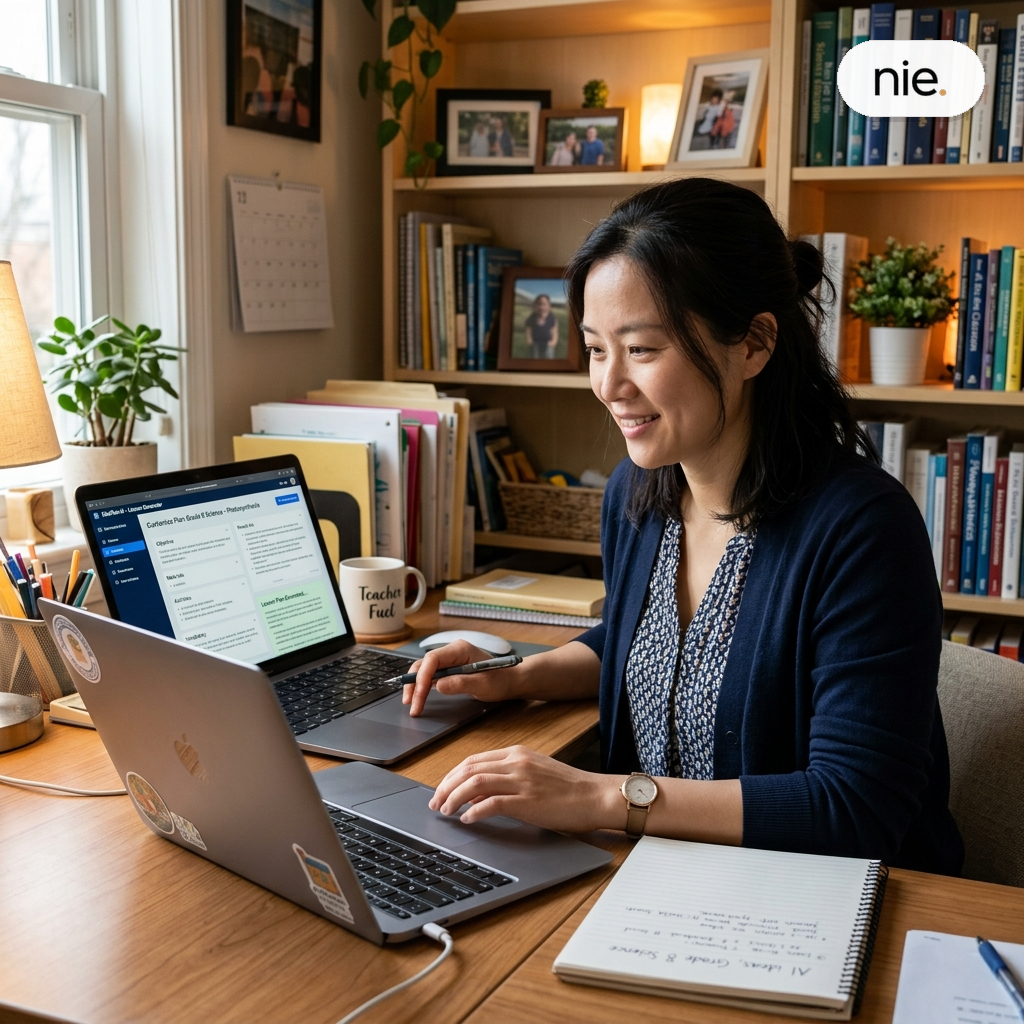
Giáo viên Mỹ thuật thường phải đối mặt với một nghịch lý: làm sao để cá nhân hóa lộ trình sáng tạo cho hàng chục học sinh cùng lúc mà không làm mất đi dấu ấn cá nhân? Việc cầm tay chỉ việc trong các lớp học đông đúc vốn đã bất khả thi. Khi nhắc đến AI môn Mỹ thuật, nhiều người ngay lập tức mơ về một cỗ máy thay thế tư duy hội họa, nhưng sự thật nghiệt ngã là công nghệ này chỉ là một công cụ lọc dữ liệu thô. Nếu giáo viên không biết cách đặt câu hỏi, thứ họ nhận lại chỉ là những hình ảnh vô hồn, thiếu chiều sâu thẩm mỹ.
Sức mạnh thực sự của AI nằm ở việc giải phóng thời gian khỏi những tác vụ hành chính tẻ nhạt. Khi một công cụ có thể tạo ra 50 mẫu bố cục cho bài tập bố cục hình mảng trong vài giây, giáo viên có thêm thời gian để phân tích tư duy thị giác cùng học trò. Tuy nhiên, ranh giới giữa việc ứng dụng công cụ và sự lười biếng tư duy rất mong manh. Chúng ta đang chứng kiến sự ra đời của một thế hệ học sinh có thể vẽ bằng lệnh (prompt) nhưng lại loay hoay khi đối mặt với bảng màu thật. Liệu giáo viên có đang dạy các em làm chủ công cụ, hay chỉ đang dạy các em cách phục tùng thuật toán?
Bản chất cốt lõi của Generative AI trong giảng dạy mỹ thuật
Hiểu đơn giản, AI tạo sinh không sáng tạo; nó tái cấu trúc dựa trên xác suất của hàng tỷ dữ liệu hình ảnh. Đối với môn Mỹ thuật, đây là kho lưu trữ tham chiếu khổng lồ. Giáo viên có thể dùng các mô hình ngôn ngữ lớn (như ChatGPT hoặc Claude) để soạn giáo án phân hóa. Thay vì soạn một bài giảng chung cho cả lớp, giáo viên nhập yêu cầu về năng lực của từng nhóm học sinh, AI sẽ tạo ra các hướng dẫn thực hành từ cơ bản đến nâng cao. Điểm yếu là AI thường xuyên “ảo tưởng” về các nguyên tắc mỹ thuật cơ bản như luật xa gần hoặc cấu trúc giải phẫu. Người cầm lái vẫn phải là giáo viên. Nếu thiếu đi nhãn quan của một chuyên gia, học sinh sẽ tiếp nhận những lỗi sai kỹ thuật một cách thụ động.
Hiệu quả ứng dụng và so sánh công năng
| Công cụ | Ứng dụng thực tế | Giới hạn cần lưu ý |
|---|---|---|
| AI tạo văn bản | Soạn giáo án, lập kế hoạch bài tập | Thiếu tư duy sư phạm đặc thù |
| AI tạo hình ảnh | Minh họa, tạo nguồn cảm hứng | Lỗi cấu trúc, thiếu chiều sâu thực tế |
Quy trình ứng dụng AI chuẩn
Rào cản thực tế và cách vượt qua
Rủi ro lớn nhất là sự đồng nhất hóa tư duy. Khi mọi học sinh đều dùng chung một bộ lọc AI, các bài vẽ sẽ mang cùng một phong cách “nhựa”. Để giải quyết, giáo viên phải coi AI là “đối thủ phản biện” chứ không phải trợ lý tạo ra kết quả cuối cùng. Khi chấm điểm, đừng đánh giá dựa trên độ hoàn thiện của hình ảnh mà hãy dựa trên quá trình tư duy logic trong các dòng lệnh (prompt) và cách học sinh chỉnh sửa kết quả của máy tính. Nếu học sinh chỉ việc nhấn nút tạo ảnh mà không thể giải thích tại sao mình chọn bố cục đó, đó là thất bại của phương pháp dạy học.
FAQ: Giải đáp thực chiến
AI có thể thay thế giáo viên trong việc chấm điểm môn Mỹ thuật không?
Không. AI có thể đánh giá được các tiêu chí kỹ thuật như tỷ lệ hay độ cân bằng màu sắc, nhưng nó hoàn toàn mù tịt trước cảm xúc và ý niệm nghệ thuật. Chấm điểm mỹ thuật cần sự đồng cảm và hiểu biết về ngữ cảnh văn hóa – thứ mà thuật toán chưa thể chạm tới.
Làm sao để học sinh không phụ thuộc hoàn toàn vào AI khi làm bài tập về nhà?
Hãy yêu cầu học sinh nộp kèm “nhật ký tư duy”. Yêu cầu các em trình bày từ bản phác thảo tay đến quá trình đặt lệnh AI và cuối cùng là các thao tác chỉnh sửa thủ công trên phần mềm đồ họa. Phải có dấu vết của con người trong sản phẩm.
Chi phí triển khai AI trong trường học có quá đắt đỏ?
Nhiều công cụ AI hiện nay có phiên bản miễn phí đủ dùng cho giáo dục. Vấn đề không nằm ở chi phí tài chính, mà là chi phí đào tạo giáo viên làm sao để sử dụng chúng một cách có đạo đức và kỹ năng.
Tóm lại, công nghệ chỉ là tấm gương phản chiếu năng lực người dùng. Để xây dựng một môi trường giảng dạy bền vững, các trường học cần những nền tảng quản lý và hạ tầng công nghệ ổn định. Tại NIE.vn, chúng tôi cung cấp các giải pháp thiết kế website chuẩn SEO, phần mềm bản quyền và hệ thống E-learning chất lượng cao, giúp các đơn vị giáo dục tối ưu hóa quy trình quản lý hành chính để tập trung nguồn lực vào việc khai phá tiềm năng nghệ thuật của học sinh. Sự kết hợp giữa hạ tầng kỹ thuật đáng tin cậy của Hộ kinh doanh Nguyễn Thông và tư duy sư phạm sắc sảo chính là con đường đi đúng đắn nhất.
2. English Version
Art teachers frequently grapple with a persistent paradox: how to personalize the creative journey for dozens of students simultaneously without diluting the authenticity of their individual voices? In the bustling environment of a crowded classroom, hands-on, one-on-one guidance is often a logistical impossibility. When the conversation shifts to AI in Art Education, many immediately fantasize about a machine capable of replacing the cognitive heavy lifting of artistic creation. The cold, hard truth, however, is that this technology is merely a data-filtering engine. If a teacher—or a student—lacks the expertise to frame the right questions, the output is inevitably a series of soulless images, devoid of any genuine aesthetic depth.
The true power of AI lies in its ability to reclaim time lost to tedious administrative drudgery. When a tool can churn out 50 layout variations for a composition exercise in mere seconds, teachers gain the breathing room necessary to engage deeply with their students’ visual thinking. Yet, the line between leveraging a tool and succumbing to intellectual sloth is razor-thin. We are witnessing the emergence of a generation adept at “prompting” but paralyzed when confronted with a physical palette and a blank canvas. Are we teaching our students to master these tools, or are we inadvertently training them to serve the algorithm?
The Core Nature of Generative AI in Art Instruction
Simply put, generative AI does not “create” in the human sense; it reconstructs visual data based on the probabilities derived from billions of images. In the context of art education, this is a gargantuan reference library. Teachers can utilize Large Language Models (such as ChatGPT or Claude) to architect differentiated lesson plans. Instead of deploying a one-size-fits-all lecture, educators can input specific competency levels for different student groups, prompting the AI to generate scaffolded instructions ranging from foundational techniques to advanced concepts. The pitfall? AI frequently “hallucinates” regarding basic artistic principles, such as atmospheric perspective or complex anatomical structures. The teacher must remain the pilot. Without the critical eye of an expert, students will passively internalize technical fallacies as absolute truth.
Application Efficiency and Functional Comparison
| Tool Category | Practical Application | Critical Limitations |
|---|---|---|
| Text-based AI | Lesson planning and curriculum structuring | Lack of nuanced pedagogical insight |
| Image-based AI | Conceptualization and mood-boarding | Structural inaccuracies and lack of artistic intent |
Standardized AI Application Workflow
Practical Barriers and Navigating the Future
The most significant danger is the homogenization of creativity. When every student relies on the same set of AI filters, the resulting body of work begins to share a sterile, “plastic” aesthetic. To mitigate this, educators must position AI as a “dialectical partner” rather than an engine for the final product. When grading, move away from evaluating the polished finish of an image and instead assess the logic behind the prompts and the iterative process of human-led refinement. If a student can merely press a button to generate a composition but cannot articulate the reasoning behind their structural choices, the instructional method has failed.
FAQ: Practical Perspectives
Can AI replace teachers in grading art assignments?
Absolutely not. While AI can evaluate technical metrics like ratio, symmetry, or color balance, it is entirely blind to the emotional weight and conceptual narrative of a piece. Evaluating art requires deep empathy and an understanding of cultural context—realms where current algorithms are still profound strangers.
How can we prevent student dependency on AI for homework?
Mandate the submission of a “thought journal.” Require students to present everything from their initial hand-drawn sketches to the evolution of their prompt-crafting process, and finally, their manual adjustments in design software. There must be unmistakable traces of human intention in every submission.
Is the cost of implementing AI in schools prohibitively high?
Many robust AI tools currently offer freemium tiers sufficient for educational purposes. The hurdle is not financial capital; it is the “human capital”—the investment in professional development to ensure teachers use these tools with both ethical integrity and high-level technical proficiency.
In short, technology is merely a mirror reflecting the capability of its user. To foster a sustainable educational environment, schools require robust management platforms and stable technological infrastructure. At NIE.vn, we specialize in providing SEO-optimized website solutions, licensed software, and high-quality E-learning ecosystems. We empower educational institutions to streamline administrative burdens, allowing them to focus their primary resources on unearthing the artistic potential of their students. The synergy between the reliable technical infrastructure provided by Nguyen Thong Business Household and astute pedagogical strategy is the most effective path forward in this digital era.
3. 中文版
美术教师们经常面临一个深刻的悖论:如何在不牺牲学生个人艺术底蕴的前提下,为数十名学生量身定制创作路径?在人满为患的课堂中,手把手的辅导早已变得不切实际。谈及美术教育中的AI技术,许多人会立刻联想到一个能够替代艺术思维的智能机器,但残酷的事实是,这项技术本质上只是一个原始数据的过滤器。如果教师缺乏引导式的提问能力,他们最终得到的只会是空洞且缺乏审美深度的平庸图像。
AI真正的核心竞争力在于将教育者从繁琐的行政任务中解放出来。当某个工具能在数秒内生成50种构图方案供学生参考时,教师便获得了宝贵的时间,用于与学生深入探讨视觉思维的本质。然而,在应用工具与思维懒惰之间,界限极其模糊。我们正目睹着这样一代学生的诞生:他们擅长使用指令(prompt)绘画,却在面对真实的调色板时手足无措。教师们究竟是在教授学生驾驭工具的艺术,还是仅仅在训练他们成为算法的“奴隶”?
生成式AI在美术教学中的核心本质
简而言之,生成式AI并非真正的“创造”;它是基于数以亿计的图像数据概率进行重组。对于美术学科而言,这是一个巨大的素材参考库。教师可以利用大语言模型(如ChatGPT或Claude)来撰写差异化教学方案。与其为全班准备一套千篇一律的教案,教师只需输入不同学生群体的能力评估,AI便能生成从基础到进阶的定制化教学指导。但其短板在于,AI常常会产生“幻觉”,在透视规律或人体解剖结构等美术基本功上频繁出错。因此,教师必须始终是“掌舵人”。如果没有专业审美视野的审视,学生将毫无防备地习得错误的技法。
应用效率与功能对比
| 工具类别 | 实际应用场景 | 必须注意的局限性 |
|---|---|---|
| 文本生成AI | 教案编写、教学任务规划 | 缺乏特定教学法的深层逻辑 |
| 图像生成AI | 参考图生成、激发创作灵感 | 结构误差、缺乏真实的艺术触感 |
标准AI应用流程
现实障碍与突破之道
最大的风险在于思维的同质化。当所有学生都使用同一套AI过滤器时,作品往往会带上一种塑料感的“AI味”。为了解决这一问题,教师必须将AI视为“论辩对手”,而非生成最终结果的捷径。在评估过程中,切勿仅以图像的精美度作为评分标准,而应关注指令(prompt)背后展现的逻辑思维链条,以及学生对机器输出结果进行后续手动修正的能力。如果学生只是机械地按下生成键,却无法解释为何选择某种构图或配色,那么这就是教学法的失败。
FAQ:实战问答
AI能否替代教师进行美术作业评分?
不能。AI或许可以量化评估透视比例或色彩平衡等技术性指标,但它对情感表达、艺术意境和审美哲学完全“失明”。美术评分需要人类的共情能力与对文化语境的深层解读,这些是目前算法无法触及的领域。
如何防止学生在完成作业时完全依赖AI?
要求学生提交“思维日志”。要求他们展示从手绘草图到AI指令生成,再到后期图形软件手动修改的全过程。作品中必须留存人类创作的足迹,而非单纯的机器输出。
在学校推广AI教学的成本是否过高?
许多主流AI工具均提供教育版或免费版,足以支撑基础教学。核心障碍并非财务成本,而是如何培训教师以道德、专业的方式驾驭这些技术。
综上所述,技术不过是用户能力的镜像。为了构建可持续的艺术教学环境,学校需要稳定可靠的数字化管理平台与技术支撑。在 NIE.vn,我们专注于提供行业领先的SEO标准化网站设计、版权软件集成及高质量的E-learning系统,助力各类教育机构优化行政管理流程,将宝贵的资源聚焦于挖掘学生的艺术潜能。将 阮通个体经营户(Hộ kinh doanh Nguyễn Thông) 稳健的技术基础设施与敏锐的教学洞察力有机结合,这正是教育数字化转型的必由之路。
🤖 Đội Ngũ AI Tự Hành 24/7
Tự động hóa quy trình nghiệp vụ, cào dữ liệu, xử lý tài liệu và đối soát báo cáo liên tục không ngừng nghỉ.
✍️ AI Sáng Tạo Nội Dung
Tự động viết bài chuẩn SEO, thiết kế Infographic và phân phối đa kênh lên Website, Facebook Fanpage.
🔗 Kết Nối n8n & Webhooks
Tích hợp liền mạch với Google Workspace, CRM, Zalo OA, Telegram và hệ thống cơ sở dữ liệu doanh nghiệp.
🧠 Đa Mô Hình AI Tiên Tiến
Ứng dụng linh hoạt Google Gemini Pro, OpenAI GPT, Claude 3.5 và các mô hình mã nguồn mở DeepSeek/Ollama.
🎓 Khóa Học AI Thực Chiến
Chương trình đào tạo từ cơ bản đến nâng cao: Làm chủ AI Agents, Prompt Engineering và Tự động hóa 0đ chi phí.
💎 Tài Khoản AI Doanh Nghiệp
Cung cấp gói tài khoản Google One 2TB, Gemini Advanced, ChatGPT Plus bản quyền giá ưu đãi.
🏢 Đơn Vị Pháp Lý Rõ Ràng
HỘ KINH DOANH CÔNG NGHỆ VÀ GIÁO DỤC NGUYỄN THÔNG (MST: 6000861747-001). Cung cấp hóa đơn và hợp đồng đầy đủ.
🔒 Bảo Mật Dữ Liệu Khách Hàng
Tuân thủ nghiêm ngặt Nghị định 13/2023/NĐ-CP về bảo vệ dữ liệu cá nhân và bí mật kinh doanh của khách hàng.