

Vibe Coding on Google Antigravity: The Art of Intuitive Engineering & The Multi-Agent Revolution
Imagine architecting a sophisticated SaaS platform, a real-time adaptive EdTech application, or an omni-channel automated pipeline in a single afternoon—without manually keying in a single line of syntactic boilerplate. You are no longer wrestling with misplaced semicolons or pulling all-nighters traversing Stack Overflow to untangle brittle dependency trees. Instead, you sit back with a warm cup of coffee, immerse your mind in the fluid stream of ideas, converse with the system in natural language, and watch lines of code autonomously materialize, compile, self-heal, and take shape before your eyes. Welcome to “Vibe Coding” on Google Antigravity—the most seismic evolutionary leap in software engineering since the genesis of high-level programming languages.
📑 Executive Contents: Mastering the Art of Vibe Coding in 2026
- 1. The “Vibe Coding” Seismic Shift: When Programming Becomes an Art of Intuition & Dialogue
- 2. Google Antigravity: The Definitive Sanctuary for the Modern Vibe Coder
- 2.1 What is Antigravity? Google & DeepMind’s Ultimate Agentic Coding Environment
- 2.2 The Multi-Agent Engine: The Developer as Orchestrator & Maestro
- 2.3 Decoupling Planning Mode from Execution Mode: Strategic Deliberation Before Execution
- 2.4 The Power of Living Artifacts & Generative UI: Real-Time Interactive Synthesis
- 3. Battlefield Field Report: A 30-Minute Vibe Coding Sprint from Concept to Shipped Application
- 4. The “Vibe Without Chaos” Playbook: Mastering the Autonomous Machine
- 5. The Future of the Software Engineer: Evolution, Not Obsolescence
1. The “Vibe Coding” Seismic Shift: When Programming Becomes an Art of Intuition & Dialogue
Across more than seven decades of computing history, programming has been fundamentally defined as a meticulous technical discipline—demanding unforgiving formal logic, mathematical rigor, and the memorization of thousands of arcane syntactic rules. Traditional software developers spent the lion’s share of their cognitive bandwidth juggling function signatures, manual type systems, defensive exception handling, parsing dense API schemas, and wrestling with pedantic compiler errors.
Yet, as we traverse the 2025–2026 horizon, a profound tectonic disruption is reordering the entire landscape of computing: The Emergence of the “Vibe Coding” Philosophy.
1.1 The Genesis: Andrej Karpathy and a Historical Inflection Point
The term “Vibe Coding” was coined and thrust into global discourse by Andrej Karpathy—former Director of AI at Tesla and founding member of OpenAI. In a post that reverberated across the global developer community, Karpathy articulated:
“There is a whole new kind of coding I call ‘Vibe Coding’—where you entirely give in to the vibes, embrace every fleeting burst of inspiration, and almost forget that actual code exists underneath. I just see what I want, say what I think, ask the AI to run it, and keep rolling. This is no longer mechanical typing; this is the pure, unadulterated flow of creative cognition.”
Karpathy’s observation was far from hyperbole; it captured an epochal cognitive migration: Natural Language has definitively ascended as the most powerful programming language on Earth. The frictional barrier between human mental abstraction and machine execution has collapsed to near zero.
1.2 Demystifying “Vibe Coding”: Thriving in the Flow State
What, then, is the ontological core of Vibe Coding? At NIE.vn, we formulate it as:
💡 The Core Definition at NIE.vn:
Vibe Coding is an intent-centric paradigm of software creation where the human operates as a strategic visionary and aesthetic curator. Rather than directly mutating source code files, the engineer leverages intuition, product domain empathy, and natural language dialogue to direct an autonomous multi-agent ecosystem that plans architectures, synthesizes code, verifies integrity, and orchestrates deployment within a frictionless, continuous feedback loop.
When engaging in Vibe Coding, an engineer enters an elevated psychological state known as the Flow State. In traditional software development, this flow state is brutally fragile: just as a developer conceives an elegant feature, an obscure library dependency collision (such as an npm version clash) halts progress for 45 minutes of log spelunking. Cognitive momentum evaporates.
In Vibe Coding, the cognitive thread never snaps. Whenever an anomaly emerges, the agentic runtime automatically ingests the console telemetry, diagnoses root causes, discreetly generates an atomic patch, and re-executes tests. The human mind remains locked onto the ultimate questions: “Whom does this product serve? Is the user experience intuitive and delightful? Does this deliver undeniable core value?”
1.3 Comparative Matrix: Traditional Coding vs. Copilot Era vs. Multi-Agent Vibe Coding
To illustrate this epochal paradigm shift with clarity, examine the comparative evolution across the three eras of software engineering:
| Comparison Dimension | Traditional Coding (Pre-2023) | The Copilot Era (2023 – 2024) | Multi-Agent Vibe Coding (2025 – 2026) |
|---|---|---|---|
| Human Role | Manual Typist & Implementer | Suggestion Reviewer / Tab Key Operator | Director & Chief Architect (Maestro / Orchestrator) |
| Control Interface | Formal Syntax (Java, Python, C++, TypeScript) | In-line Comments & Discrete Prompts in IDE | Natural Language, Intuition, Rich Contextual Dialogue |
| System Autonomy | 0% (Completely reliant on manual human execution) | ~15% (Local autocomplete of adjacent code lines) | 90% – 95% (Autonomous command execution, file patching, debugging, testing, deployment) |
| Scope of Execution | Line-by-line, isolated subroutines | Active open file buffer | Repository-wide, multi-tier services, cloud infrastructure |
| Concept-to-MVP Velocity | Weeks to months | Days to weeks | Minutes to hours |
2. Google Antigravity: The Definitive Sanctuary for the Modern Vibe Coder
While the romantic notion of “Vibe Coding” sounds captivating, attempting it inside a rudimentary chat interface or a standard IDE extension quickly spirals into catastrophe: hallucinated APIs, tedious copy-pasting, indentation errors, lost conversational state, and code that collapses immediately at runtime.
To unleash the true velocity of Vibe Coding, one demands an environment engineered from the ground up for the Autonomous Agent Era. Google Antigravity—birthed from the frontier laboratories of Google AI and DeepMind—represents precisely this architectural breakthrough.
2.1 What is Antigravity? Google & DeepMind’s Ultimate Agentic Coding Environment
Unlike legacy editors such as VS Code or JetBrains, which were architected in prior decades around human manual text manipulation, Google Antigravity operates on a foundational axiom: “AI is a first-class citizen; the human is the visionary director.”
The Antigravity platform comes equipped with a multi-tiered secure sandbox where AI agents are endowed with genuine agency and full tool use:
- Direct File System Governance: Precision diff-patching and surgical atomic edits across source files without corrupting surrounding codebase architecture.
- Background Headless Terminal & Command Runner: Automated execution of PowerShell/Bash environments to resolve packages, spin up local test servers, and compile artifacts without locking the user interface.
- Asynchronous Background Workflows: Protracted tasks like deep security audits, model fine-tuning, or executing thousands of test cases run silently behind the scenes, waking the engineer via proactive Reactive Notifications.
🌌 Why the Name “Antigravity”?
In classical software development, “gravity” represents the crushing friction of technical debt, grueling debugging marathons, brittle Docker configurations, and package collisions. Google Antigravity was engineered to nullify this technical friction—levitating the engineer into the unencumbered realm of pure creative strategy, transforming software development into a weightless, frictionless endeavor.
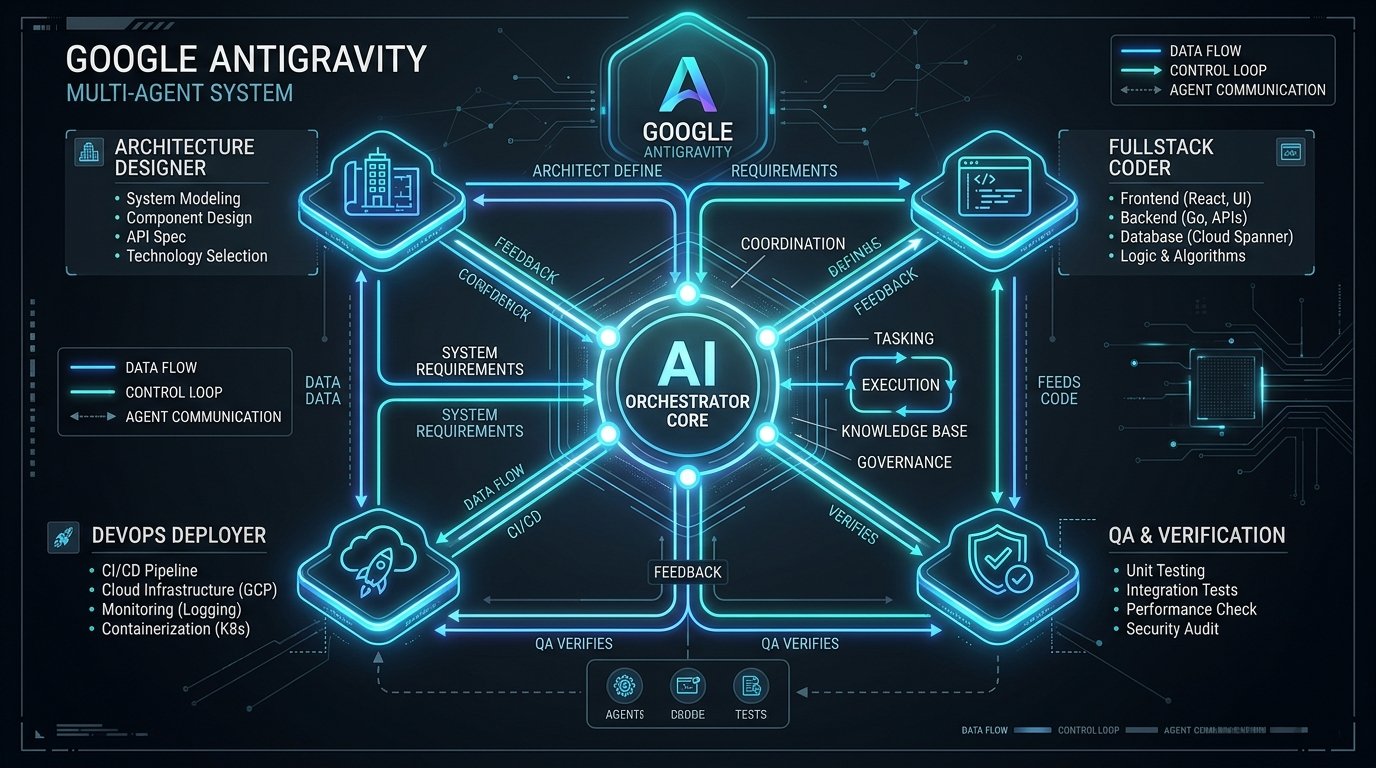
Architectural blueprint of Google Antigravity Multi-Agent System: AI Orchestrator Core orchestrating specialized autonomous sub-agents.
2.2 The Multi-Agent Engine: The Developer as Orchestrator & Maestro
The secret weapon catapulting Google Antigravity beyond single-model LLM wrappers is its Hierarchical Multi-Agent Architecture.
When you articulate a grand vision inside Antigravity, you do not converse with a lone model. You interface with an Orchestrator Agent. This master conductor rapidly decomposes the problem and mobilizes a specialized ensemble of sub-agents working concurrently:
🏗️ Architecture Agent
Schematizes folder hierarchies, designs normalized database schemas, blueprints RESTful/GraphQL contracts, and enforces rigorous architectural scalability.
💻 Fullstack Coder Agent
Synthesizes backend services (Python, Node.js, Go) and dynamic frontends (React, Vue, Tailwind CSS) at thousands of lines of idiomatic code per minute.
🔍 QA & Tester Agent
Constructs unit and integration test suites, executes strict linters, and commands headless browsers to simulate real user journeys and intercept regressions.
🚀 DevOps & Deploy Agent
Containerizes software via Docker, establishes CI/CD build pipelines, manages ingress routes, and orchestrates zero-downtime cloud deployments.
In this grand technological symphony, you are the Maestro. You do not need to personally bow every violin string or blow every brass trumpet. You set the tempo, preserve the musical soul, and signal thematic transitions. The autonomous ensemble executes the score with consummate precision.
2.3 Decoupling Planning Mode from Execution Mode: Strategic Deliberation Before Execution
The fatal flaw of novice AI workflows is allowing models to recklessly rush into code authoring upon receiving a brief prompt. This invariably results in fragmented architectures, orphaned dependencies, and system breakdown after a handful of conversational turns.
Google Antigravity eliminates this through a strict decoupling: Planning Mode vs. Execution Mode:
- Phase 1 – Cognitive Planning: Upon receiving a prompt, write access to the filesystem is locked. The agent interrogates the existing repository, builds dependency graphs, identifies architectural bottlenecks, and constructs a detailed, numbered Action Plan.
- Phase 2 – Strategic Human Review: This blueprint is surfaced as an interactive Living Artifact. The human engineer inspects the design, refines technical trade-offs, substitutes third-party libraries, or tunes logic before a single line of production code is written.
- Phase 3 – Disciplined Execution: Only upon explicit human authorization does the environment switch to Execution Mode. Specialized sub-agents systematically execute each milestone, checking off tasks and running validation suites at every juncture.
2.4 The Power of Living Artifacts & Generative UI: Real-Time Interactive Synthesis
Software engineers are inherently visual, spatial thinkers. We do not evaluate software through monolithic walls of text; we demand immediate tactile feedback to judge aesthetics, responsiveness, and usability.
This is why Google Antigravity champions Living Artifacts harmonized with Generative UI:
- Interactive Web Previews: When requesting a web dashboard, Antigravity doesn’t merely output raw HTML/CSS. It renders an active, clickable live preview directly within an adjacent panel, allowing immediate manual interaction.
- Dynamic Architectural Visualizations: Generates real-time Mermaid diagrams illustrating data flows, microservices topology, and finite state machines.
- Co-authoring Workspaces: You can steer development through natural language or voice while simultaneously annotating, editing, and refining artifacts in a seamless multi-modal feedback loop.
3. Battlefield Field Report: A 30-Minute Vibe Coding Sprint from Concept to Shipped Application
To give NIE.vn readers an authentic glimpse into this paradigm shift, let us walk through a real-world, 30-minute development sprint on Google Antigravity: Building an “Adaptive AI Mathematics Tutor with Real-Time Learning Diagnostics”.
3.1 Project Inception: Transmuting Nebulous Ideas into Architectural Blueprints in 60 Seconds
The developer opens Google Antigravity, takes a sip of Earl Grey tea, and submits the following natural language directive:
“I want to build an EdTech platform helping high school students prepare for national mathematics examinations. The app requires a sleek Glassmorphism UI, real-time LaTeX formula rendering, an AI diagnostic engine that pinpoints student weaknesses across mathematical topics, and dynamic adaptive practice generation using Item Response Theory. Blueprint the architecture and execute full-stack.”
Instantly, Antigravity’s Planning Mode activates. The Orchestrator Agent avoids premature code generation. Within 45 seconds, an interactive Living Artifact materializes on screen:
- System Architecture: Frontend powered by Next.js 15, Tailwind CSS, and KaTeX for mathematical notation; lightweight FastAPI backend, SQLite + SQLite-Vec for local vector retrieval of similar practice problems; generative AI integration via the Gemini API.
- 5-Phase Implementation Plan: 1) Project scaffolding & virtual environments; 2) Student diagnostic database schema; 3) Adaptive difficulty scoring engine (Item Response Theory); 4) Interactive Glassmorphic UI; 5) Automated E2E verification.
The developer reviews the blueprint, nods in agreement, and clicks: “Proceed to Execute”.
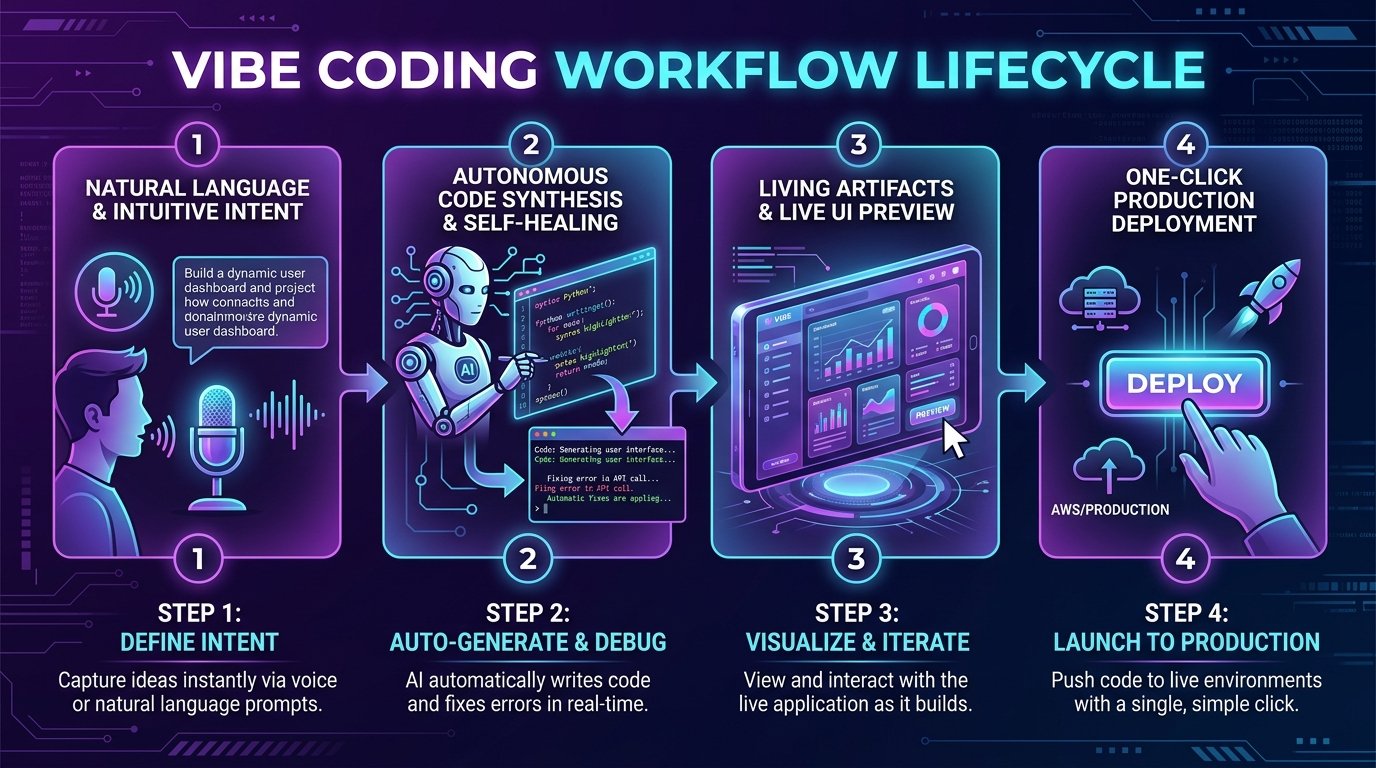
The 4-Step Vibe Coding Workflow Lifecycle: From natural language intent to one-click autonomous deployment.
3.2 Autonomy in Motion: Spawning Terminals, Installing Dependencies, Iterative Debugging, and Deployment
From this moment, the magic unfolds. On-screen processes synchronize like a virtuoso engineer executing at lightspeed:
- Minute 3: The sub-agent spawns a background terminal, provisions a Python
venv, runspip install fastapi uvicorn pydantic, and scaffolds the Next.js frontend usingnpx create-next-app@latest. - Minute 8: Backend services are fully assembled. Unexpectedly, a version mismatch triggers an
ImportErrorwithpydantic-settingsduring FastAPI server startup. Before the developer can even furrow a brow, the agent intercepts the traceback from stderr, resolves the compatible dependency version, and boots the server cleanly. - Minute 16: KaTeX rendering exhibits character corruption with accented text. The QA agent triggers a linter, pinpoints an unescaped character inside the regex preprocessor, and applies a precise two-line patch to resolve the issue.
- Minute 24: A luminous Glassmorphic dashboard featuring radar charts across six mathematical sub-disciplines renders inside the Live Preview panel. When a user inputs a calculus problem, the AI returns an articulate, step-by-step derivation accompanied by positive pedagogical reinforcement.
3.3 The “Zero-Resistance Coding” Experience: The Sovereign Power of the Creator
Throughout the entire 30-minute session, the developer:
- Never wrote a single line of boilerplate like
def async function():. - Never searched how to center a
<div>in CSS. - Never opened Google to troubleshoot a port 8000 socket conflict.
All human input was elevated to aesthetic and strategic guidance: “The submission button feels muted; shift it to a neon purple gradient with a ripple micro-interaction on hover”—and voilà! The interface adapted within five seconds. This is Zero-Resistance Coding—where the latency between human imagination and digital reality converges to zero.
4. The “Vibe Without Chaos” Playbook: Mastering the Autonomous Machine
Yet, like any double-edged sword, unbridled Vibe Coding harbors fatal hazards when practiced naively. Surrendering 100% of your codebase to autonomous models without rigorous governance quickly yields unmaintainable spaghetti code, critical security exploits, and skyrocketing technical debt.
To experience the creative euphoria of Vibe Coding without compromising software integrity, the engineering leads at NIE.vn have synthesized the following Golden Principles:
4.1 Architectural Governance via Human-in-the-Loop (HITL)
Rule number one of autonomous engineering: You may delegate the generation of code, but you must never abdicate architectural stewardship.
⚠️ The Golden Rule of NIE.vn: Retain Architectural Veto Power
Establish immutable Checkpoints around critical system boundaries: Database Schemas, Authentication & JWT/OAuth mechanisms, and Production Data Mutations / Migrations. The AI must explicitly justify its technical trade-offs before you grant execution clearance.
4.2 Automated Verification: Deploying Dedicated QA & Validation Agents
How do you guarantee that an AI agent didn’t quietly break existing business logic while shipping a new feature? The answer lies in Test-Driven Development (TDD) powered by Validation Agents.
Prior to allowing an agent to author functional logic, instruct the QA Agent to establish automated test suites:
- Unit Tests & Boundary Conditions: Validate edge cases, null payloads, negative numbers, and malicious injection attempts (SQL Injection / XSS).
- Automated Regression Testing: Every code mutation triggers an automated background test run. If any test case fails, the agent is barred from marking the task complete and must autonomously roll back to the last stable commit.
4.3 Unlocking Boundless Interoperability with Model Context Protocol (MCP)
An agentic runtime remains an isolated sandbox if it cannot interact with existing enterprise software ecosystems. This is where the Model Context Protocol (MCP) shines brightest.
MCP acts as the universal USB-C standard for the artificial intelligence ecosystem. By linking Google Antigravity to MCP servers, your autonomous agents can:
- Query internal PostgreSQL or Supabase enterprise databases directly.
- Extract design tokens and component specs from Figma, converting them into pixel-perfect Tailwind CSS.
- Autonomously author GitHub Pull Requests, tag issue trackers, and request peer reviews.
- Connect directly to headless CMS or WordPress REST APIs to publish SEO-optimized technical content automatically.
4.4 Three Fatal Anti-Patterns Every Novice Vibe Coder Must Avoid
🚫 3 Critical Anti-Patterns to Eliminate Immediately:
- The Omniscience Illusion: Blindly trusting AI-generated code without inspecting execution telemetry. Always remember: AI faithfully delivers what you ask for, not necessarily what your business actually needs.
- Context Bloat: Shoveling an entire 500-page specification into a single prompt, inducing cognitive degradation in the model. Always decompose objectives into atomic tasks distributed across specialized sub-agents.
- Git Neglect: Editing files in continuous succession without establishing commit checkpoints. Force the agent to spawn dedicated feature branches, ensuring trivial rollbacks when experiments fail.
5. The Future of the Software Engineer: Evolution, Not Obsolescence
An existential question currently ripples across the global technology community: “If AI can write, debug, test, and deploy software via Vibe Coding, will human software engineers become obsolete between 2026 and 2030?”
The definitive perspective from the editorial desk of NIE.vn is unequivocal: No! Programmers are not disappearing—rather, the definition of a programmer is undergoing a profound rebirth.
5.1 Coders Aren’t Dead: The Ascendance of the AI Orchestrator
The history of computer science is fundamentally a chronicle of escalating Abstraction Layers. When Assembly language arrived, observers warned that hardware circuit engineers would lose their livelihoods. When C, Java, and Python emerged, pundits proclaimed that Assembly programmers were finished. Yet after every elevation in abstraction, the global volume of software expanded exponentially, and the demand for visionary technologists reached unprecedented heights.
Vibe Coding and Google Antigravity represent the next major abstraction layer: Elevating developers from manual bricklayers into Chief Architects of Digital Cathedrals.
5.2 The Three High-Value Capabilities of the 2026 Software Engineer
In the era of Vibe Coding, the market no longer rewards syntactic recall or typing speeds of 120 words per minute. The three gold-standard competencies commanding premium market value are:
- 1. Aesthetic Taste & Curation: AI can generate 100 frontend layouts and 50 algorithms in seconds, but which solution possesses true architectural elegance? Which micro-interaction evokes genuine customer delight? Only human empathy and refined taste can curate greatness.
- 2. Systems Thinking & Domain Expertise: Deeply understanding pedagogy, healthcare, quantitative finance, or supply chain dynamics to translate messy real-world challenges into rigorous algorithmic constraints for the multi-agent fleet.
- 3. Agentic Leadership & Orchestration: The ability to design agent topologies, structure inter-agent communication protocols, optimize cognitive contexts, and govern autonomous fleets with maximum reliability and minimal compute cost.
5.3 The Democratization of Technology: Anyone Can Be a Software Architect
The most profound humanitarian triumph of the Vibe Coding movement on Google Antigravity is the Democratization of Creation.
In years past, an impassioned mathematics teacher envisioning an interactive 3D geometry tool for rural students faced an insurmountable hurdle: endure five years of computer science education or raise tens of thousands of dollars to commission an agency. Today, armed with an internet connection and Google Antigravity, that same educator can manifest their pedagogical vision into an interactive application through natural language conversations.
Software creation is no longer the exclusive fiefdom of a technical elite; it has become an accessible medium for all of humanity to solve the world’s most urgent challenges.
🌟 Epilogue: The Time for Your Quantum Leap is Now!
The technology horizon waits for no one. Skeptics remain entangled in debates over whether AI will replace humans, while pioneering Vibe Coders are already wielding Google Antigravity to build and ship multi-million dollar platforms at unprecedented velocity.
Cast aside the fear of rigid syntax. Expand your mind, surrender to the intuitive flow, and take the pilot’s seat as an AI Orchestrator. The future of software belongs to those who dare to imagine and converse with the machine!
🤖 Đội Ngũ AI Tự Hành 24/7
Tự động hóa quy trình nghiệp vụ, cào dữ liệu, xử lý tài liệu và đối soát báo cáo liên tục không ngừng nghỉ.
✍️ AI Sáng Tạo Nội Dung
Tự động viết bài chuẩn SEO, thiết kế Infographic và phân phối đa kênh lên Website, Facebook Fanpage.
🔗 Kết Nối n8n & Webhooks
Tích hợp liền mạch với Google Workspace, CRM, Zalo OA, Telegram và hệ thống cơ sở dữ liệu doanh nghiệp.
🧠 Đa Mô Hình AI Tiên Tiến
Ứng dụng linh hoạt Google Gemini Pro, OpenAI GPT, Claude 3.5 và các mô hình mã nguồn mở DeepSeek/Ollama.
🎓 Khóa Học AI Thực Chiến
Chương trình đào tạo từ cơ bản đến nâng cao: Làm chủ AI Agents, Prompt Engineering và Tự động hóa 0đ chi phí.
💎 Tài Khoản AI Doanh Nghiệp
Cung cấp gói tài khoản Google One 2TB, Gemini Advanced, ChatGPT Plus bản quyền giá ưu đãi.
🏢 Đơn Vị Pháp Lý Rõ Ràng
HỘ KINH DOANH CÔNG NGHỆ VÀ GIÁO DỤC NGUYỄN THÔNG (MST: 6000861747-001). Cung cấp hóa đơn và hợp đồng đầy đủ.
🔒 Bảo Mật Dữ Liệu Khách Hàng
Tuân thủ nghiêm ngặt Nghị định 13/2023/NĐ-CP về bảo vệ dữ liệu cá nhân và bí mật kinh doanh của khách hàng.