
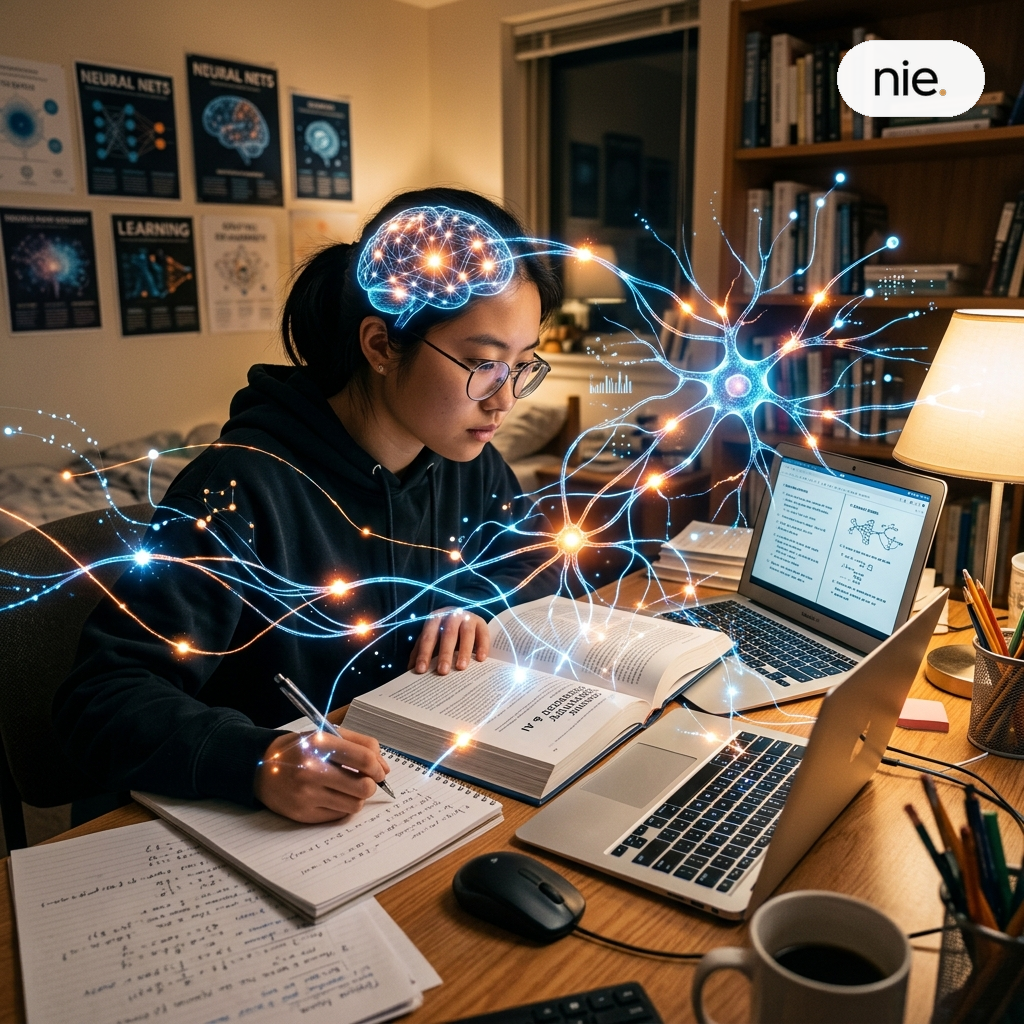
1. Phiên bản Tiếng Việt
Giáo viên Toán thường tốn hàng giờ đồng hồ để vẽ hình học không gian, gõ công thức LaTeX phức tạp hay thiết kế những slide mô phỏng biến thiên hàm số chỉ để học sinh “nhìn lướt qua” trong 5 phút. Việc áp dụng E-learning AI Toán học thường bị biến tướng thành những video minh họa màu mè nhưng thiếu chiều sâu tư duy. Khi công cụ AI hỗ trợ soạn bài xuất hiện, cơn sốt “tự động hóa hoàn toàn” khiến nhiều nhà giáo dục lầm tưởng rằng họ chỉ cần nhập một câu lệnh là có ngay bài giảng chuẩn chỉnh. Sự thật trần trụi hơn nhiều. AI không tự dưng hiểu được bản chất sư phạm hay cách diễn đạt một định lý sao cho học sinh dễ thẩm thấu. Nếu không có bộ lọc chuyên môn từ người soạn, những bài giảng này sẽ biến thành những sản phẩm rập khuôn, thiếu cá tính và đôi khi còn sai lệch về mặt logic toán học.
Bản chất của việc tích hợp AI trong giảng dạy Toán
Để vận hành hiệu quả, AI không đóng vai trò người thay thế giáo viên, mà là một cộng sự xử lý dữ liệu thô. Cơ chế của nó dựa trên việc chuyển đổi ngôn ngữ tự nhiên sang cấu trúc dữ liệu hình ảnh và kịch bản. Đối với môn Toán, rào cản lớn nhất không phải là tạo video, mà là làm sao để AI vẽ đúng hình học Euclid hoặc biểu diễn đúng đồ thị hàm số mà không bị “ảo giác” (hallucination). Các công cụ tạo slide hiện nay như Gamma hay Tome xử lý tốt bố cục, nhưng để giảng dạy Toán, giáo viên cần can thiệp sâu vào từng dòng lệnh, bắt buộc AI phải tuân thủ nghiêm ngặt các quy chuẩn ký hiệu toán học quốc tế.
So sánh giữa phương pháp truyền thống và hỗ trợ từ AI
| Tiêu chí | Giáo án truyền thống | Kết hợp E-learning AI |
|---|---|---|
| Thời gian soạn bài | Rất lâu, mất nhiều công sức vẽ hình | Tiết kiệm 60-70% nhờ tự động hóa |
| Tính trực quan | Giới hạn trong khả năng vẽ tay | Mô phỏng 3D sinh động |
| Khả năng tùy biến | Dễ dàng điều chỉnh từng chi tiết | Phụ thuộc vào kỹ năng viết prompt |
Quy trình thiết kế bài giảng tinh gọn
Sử dụng ChatGPT hoặc Claude để dàn ý hóa bài giảng, phân chia các bước giải toán logic.
Đưa dữ liệu vào các công cụ như Gamma để tạo khung sườn thị giác, chèn biểu đồ hàm số.
Tạo câu hỏi trắc nghiệm tự động từ nội dung bài giảng bằng Quizizz AI để đánh giá phản hồi.
Thách thức thực tế và rào cản triển khai
Điểm yếu chí mạng của công nghệ AI hiện nay là tính chính xác trong các phép toán phức tạp. Bạn có thể gặp tình trạng AI giải sai một phương trình bậc hai hoặc hiểu lầm ý nghĩa hình học của một định lý. Đây không phải là công cụ dành cho người lười. Người giáo viên phải là biên tập viên kỹ tính nhất. Nếu không kiểm chứng, bạn đang vô tình truyền bá kiến thức sai lệch cho học sinh. Bên cạnh đó, chi phí cho các gói AI cao cấp không hề rẻ. Hãy bắt đầu từ những công cụ miễn phí nhưng có độ tin cậy cao, học cách viết lệnh (prompt) chính xác thay vì phụ thuộc vào các tính năng tự động hoàn toàn.
FAQ – Giải đáp thắc mắc
Tại sao bài giảng AI của tôi trông rất đẹp nhưng học sinh vẫn không hiểu bài?
Vấn đề nằm ở cấu trúc sư phạm. Hình ảnh chỉ là phương tiện, không phải tư duy. Bạn cần tập trung vào việc đặt câu hỏi dẫn dắt thay vì chỉ trình chiếu thông tin.
Làm sao để đảm bảo AI không đưa ra kết quả toán học sai?
Luôn kiểm chứng kết quả từ AI bằng các phần mềm toán học chuyên dụng như Geogebra hoặc WolframAlpha. Coi AI là bộ não hỗ trợ ý tưởng, không phải là nguồn tri thức duy nhất.
Tôi nên bắt đầu từ công cụ nào là phù hợp nhất?
Hãy làm quen với ChatGPT để lên dàn ý, sau đó sử dụng Canva để thiết kế slide vì tính linh hoạt trong việc chỉnh sửa thủ công cao hơn các công cụ AI thuần túy.
Kết lại, công nghệ chỉ là đòn bẩy. Nếu bạn đang loay hoay tìm kiếm lộ trình xây dựng nền tảng E-learning cho đơn vị của mình, cần sự hỗ trợ chuyên sâu từ việc thiết kế website chuẩn SEO cho đến phát triển phần mềm bản quyền hoặc giải pháp E-learning chuyên biệt, hãy cân nhắc kết nối với các đối tác uy tín. Các dịch vụ từ NIE.vn – đơn vị trực thuộc Hộ kinh doanh Nguyễn Thông – cung cấp hạ tầng công nghệ tin cậy, giúp giải quyết bài toán vận hành phức tạp bằng sự thấu hiểu thực tế, thay vì chỉ mang đến những công cụ hào nhoáng vô dụng.
2. English Version
Mathematics teachers often spend countless hours laboring over spatial geometry diagrams, wrestling with complex LaTeX syntax, or crafting intricate slide decks to visualize functional variations—only for students to skim through them in a fleeting five minutes. The integration of AI into Mathematics E-learning has often been distorted into a parade of flashy, colorful visuals that lack true cognitive depth. With the explosion of AI-powered lesson creation tools, a “full automation” fever has swept through classrooms, leading many educators to mistakenly believe that a single prompt is all it takes to generate a polished, curriculum-ready lecture. The reality is far more sobering. AI does not inherently grasp pedagogical essence or the nuanced art of explaining a theorem so that it resonates with a student’s intuition. Without a professional lens to filter the output, these AI-generated lectures risk becoming cookie-cutter products, stripped of pedagogical character and occasionally plagued by deep logical errors.
The Essence of Integrating AI into Mathematics Instruction
To operate effectively, AI should not be viewed as a replacement for the teacher, but rather as an indispensable partner for processing raw data. Its core mechanism relies on translating natural language into visual data structures and scripted logic. In the context of Mathematics, the primary hurdle isn’t the aesthetic creation of a video; it is ensuring that the AI can render Euclidean geometry accurately or plot functional graphs without falling into the trap of “hallucinations.” Modern slide-creation tools like Gamma or Tome manage layouts with ease, but for a math-focused pedagogy, teachers must intervene at the granular command level, forcing the AI to strictly adhere to international mathematical notation standards.
Traditional Methods vs. AI-Assisted Pedagogy
| Criteria | Traditional Lesson Planning | AI-Integrated E-learning |
|---|---|---|
| Prep Time | Extremely labor-intensive, particularly with technical illustrations | 60-70% time reduction through automation |
| Visualization | Limited by manual drawing capabilities | Immersive and dynamic 3D simulations |
| Customization | Easily adjusted to specific needs | Dependent on the user’s prompt engineering skills |
A Streamlined Workflow for Lesson Design
Use ChatGPT or Claude to structure your lesson flow and sequence logical mathematical problem-solving steps.
Input data into tools like Gamma to build the visual backbone and embed functional graphs.
Automatically generate assessment questions from the lesson content using Quizizz AI to gauge student feedback.
Practical Challenges and Implementation Hurdles
The “Achilles’ heel” of current AI technology remains its accuracy with complex calculations. You may frequently encounter situations where an AI erroneously solves a quadratic equation or misinterprets the geometric implications of a theorem. This is not a tool for the lazy. The teacher must serve as the ultimate, meticulous editor. Without rigorous verification, you risk inadvertently propagating misinformation to your students. Furthermore, the cost of premium AI suites is far from negligible. It is wiser to start with high-reliability, accessible tools and master the craft of precise “prompting” rather than relying blindly on fully automated features.
FAQ – Addressing Your Concerns
Why do my AI-generated slides look stunning, yet my students still struggle to grasp the core concepts?
The issue lies in the pedagogical structure. Visuals are merely a delivery vehicle, not a substitute for critical thinking. You must shift your focus toward developing guiding questions that provoke inquiry, rather than merely broadcasting information.
How can I ensure AI doesn’t yield incorrect mathematical outcomes?
Always cross-verify AI results with specialized mathematical software like Geogebra or WolframAlpha. Treat AI as a creative partner that generates ideas, not as an infallible repository of absolute truth.
Which tool should I start with to be most effective?
Become proficient with ChatGPT for outlining your narrative, then utilize Canva for slide design, as it offers far greater flexibility for manual adjustments compared to strictly AI-only slide platforms.
In conclusion, technology is merely a lever for growth. If you are currently navigating the path toward building an E-learning foundation for your institution, and require in-depth support—ranging from SEO-optimized website architecture to proprietary software development or specialized E-learning solutions—consider connecting with reputable partners. Services from NIE.vn, a subsidiary of the Nguyen Thong Business Entity, provide a reliable technological infrastructure. They specialize in solving complex operational problems through a deep understanding of practical, real-world educational needs, rather than merely offering superficial, flashy tools that fail to provide real value.
3. 中文版
数学老师们常常花费数小时在黑板上绘制空间几何图形、敲击复杂的 LaTeX 公式,或是精心设计函数变动的演示幻灯片,仅仅为了让学生在课堂上“一瞥而过”那短短的5分钟。现今,数学领域的 AI 在线教育应用往往走入了误区:它们沦为了一些色彩斑斓却缺乏思维深度、华而不实的演示视频。随着 AI 辅助教学工具的兴起,“全自动化”的热潮让许多教育工作者产生了一种错觉,以为只要输入一条指令,就能立刻生成一套完美的教学课件。然而,现实却远比这残酷。AI 无法自动理解教育学的本质,更不懂得如何将定理以最易于学生吸收的方式表达出来。如果没有专业人员的审慎把关,这些课件最终只会沦为千篇一律的陈旧产物,不仅缺乏个性,甚至可能在数学逻辑上出现硬伤。
数学教学中深度整合 AI 的本质
AI 在数学教学中能否发挥实效,取决于其定位。它绝非教师的替代者,而是一个处理原始数据的高效合作伙伴。其运行机制在于将自然语言转化为图像数据结构和教学脚本。对于数学学科而言,最大的难点并非视频制作,而是如何确保 AI 在绘制欧几里得几何图形或呈现函数图表时,不会产生逻辑性的“幻觉”(Hallucination)。虽然 Gamma 或 Tome 等幻灯片生成工具在版式排布上表现出色,但为了实现严谨的数学教学,教师必须深入干预每一个指令细节,强制要求 AI 严格遵守国际数学符号规范。
传统教学法与 AI 辅助教学的对比
| 指标 | 传统教案 | AI 辅助在线教学 |
|---|---|---|
| 备课时长 | 耗时极长,绘图工作繁琐 | 借助自动化节省 60-70% 时间 |
| 直观性 | 受限于手绘能力 | 提供生动的 3D 模拟效果 |
| 定制化程度 | 细节易于人工调整 | 高度依赖提示词 (Prompt) 编写技能 |
精简版课件设计流程
利用 ChatGPT 或 Claude 构建教学大纲,逻辑化拆解数学问题的解题步骤。
将数据导入 Gamma 等工具,自动生成视觉框架,并插入必要的函数图表。
通过 Quizizz AI 根据教学内容自动生成测验题,及时评估学生的学习反馈。
实操挑战与落地障碍
当前 AI 技术的核心软肋在于复杂算术运算的精确度。你可能会遇到 AI 对二次方程求解错误,或曲解定理几何意义的情况。因此,这绝非为“懒惰者”准备的工具。教师必须担任最严苛的“编辑者”角色。如果不经核对直接使用,就是在向学生传授谬误。此外,高端 AI 订阅服务的成本不菲。建议从高可靠性的免费工具起步,潜心钻研精准的提示词编写技巧,而不是盲目依赖全自动化的功能。
常见问题解答 (FAQ)
问:为什么我的 AI 课件看起来精美绝伦,学生却还是听不懂?
答:核心问题在于教学结构。图像只是媒介,而非思维本身。你需要将重点放在引导式提问,而非信息的堆砌展示。
问:如何确保 AI 不输出错误的数学计算结果?
答:必须始终使用 Geogebra 或 WolframAlpha 等专业数学软件来复核 AI 的结果。请务必将 AI 视作辅助构思的“大脑”,而非唯一权威的知识源。
问:初学者应该从哪些工具入手最合适?
答:建议先从 ChatGPT 起步理清大纲,再结合 Canva 进行幻灯片设计,因为相较于纯 AI 工具,其手动编辑的灵活性更高。
总结而言,技术仅仅是杠杆。如果您正在寻求构建教育机构在线学习平台的路径,从 SEO 标准化网站设计到正版软件开发,甚至是深度定制的 E-learning 解决方案,请务必咨询专业合作伙伴。来自 NIE.vn(隶属于 Nguyen Thong 个体工商户)的专业服务,凭借对行业实践的深刻洞察,提供坚实的技术底层支持,旨在解决复杂的运营难题,而非仅仅提供华而不实的工具。选择专业,方能事半功倍。
📚 Chuẩn Công Văn 5512/BGDĐT
Đầy đủ 4 hoạt động sư phạm, xác định rõ phẩm chất & năng lực học sinh, phủ kín 3 bộ sách KNTT, Cánh Diều, Chân Trời.
🎯 Khung Đánh Giá Toàn Diện
Thiết kế sẵn phiếu học tập, tiêu chí đánh giá thường xuyên (Rubrics) hỗ trợ giáo viên tiết kiệm 80% thời gian soạn giáo án.
⚡ Định Dạng GIFT Chuẩn Moodle
Hàng ngàn câu hỏi trắc nghiệm kèm lời giải chi tiết, nạp thẳng vào Moodle LMS chỉ trong 1 cú nhấp chuột.
📊 Ma Trận 4 Mức Độ Phân Hóa
Phân bổ khoa học: Nhận biết (40%), Thông hiểu (30%), Vận dụng (20%) và Vận dụng cao (10%).
📝 File Word (.docx) 100%
Định dạng trang in chuẩn A4, công thức MathType chuẩn xác, dễ dàng chỉnh sửa thông tin giáo viên và trường học.
🎨 Slide Bài Giảng Điện Tử
Bài giảng PowerPoint sinh động, tích hợp mini-game trắc nghiệm khởi động tạo hứng thú học tập cho học sinh.
🏫 Tích Hợp LMS Trường Học
Đóng gói Course Backup (.mbz) tiện lợi, tự động chấm điểm và xuất bảng điểm Excel cho giáo viên.
📥 Tải Nhanh Google Drive
Kho học liệu lưu trữ trên Google Drive tốc độ cao, cập nhật bổ sung giáo án mới hoàn toàn miễn phí.