

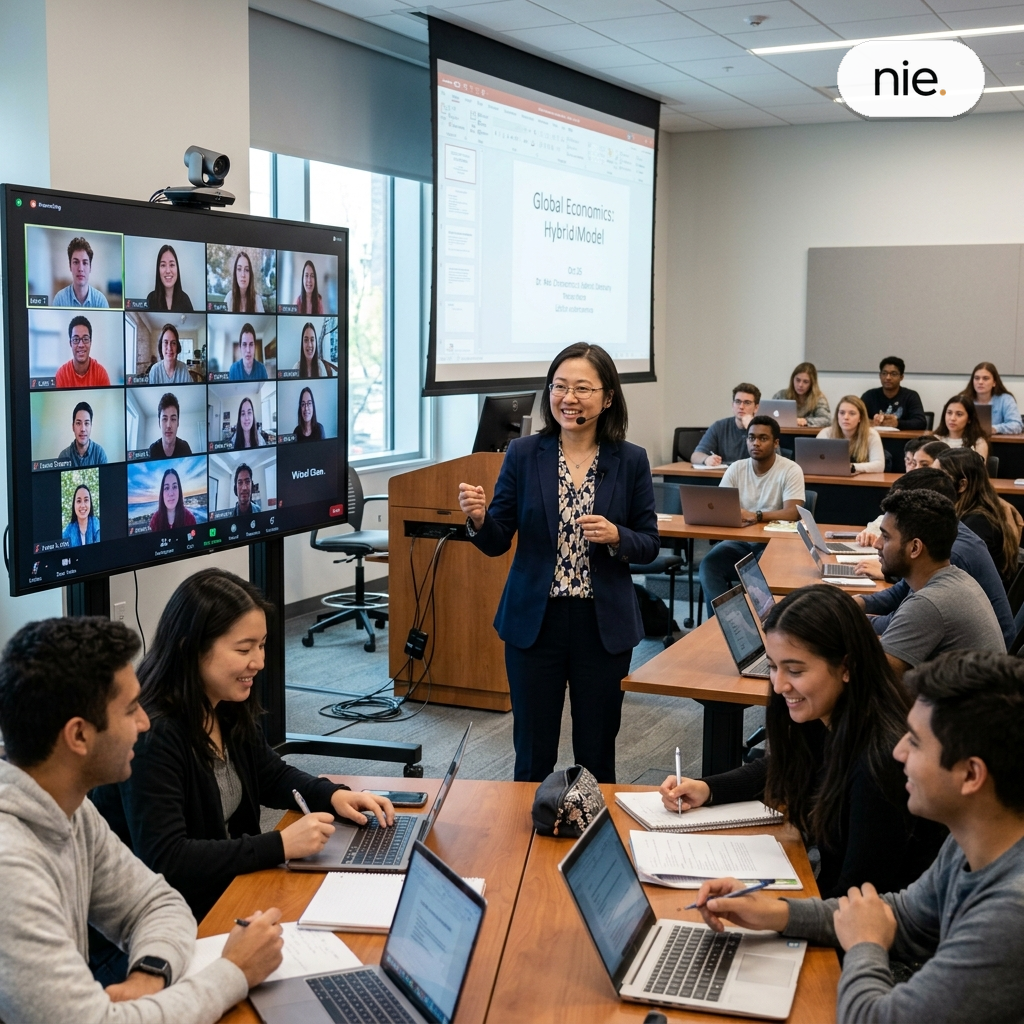
1. Phiên bản Tiếng Việt
Giáo viên Toán vẫn đang loay hoay với những chồng bài kiểm tra chất cao như núi và hàng giờ liền soạn giáo án thủ công. Vấn đề nằm ở chỗ, dù có cố gắng đến đâu, con người vẫn là một cỗ máy xử lý dữ liệu chậm chạp so với những gì AI có thể làm được. Nhiều người sợ AI sẽ thay thế giáo viên. Nỗi sợ này vô căn cứ. AI chỉ giỏi tính toán và nhận diện mẫu, nó không thể dạy cách tư duy phản biện hay thấu cảm với những khó khăn của học sinh khi đối mặt với một phương trình khó. Tuy nhiên, nếu cứ khăng khăng dùng phương pháp truyền thống, giáo viên sẽ nhanh chóng bị quá tải.
Ứng dụng AI môn Toán học không phải là phép màu để biến một giáo viên bình thường thành thiên tài sư phạm chỉ sau một đêm. Đó là sự thay đổi về cách vận hành. Khi giao việc lặp lại cho máy móc, giáo viên có thêm không gian để làm điều quan trọng nhất: dẫn dắt học sinh. Nhưng làm sao để bắt đầu mà không rơi vào cái bẫy phụ thuộc công nghệ? Phải có chiến thuật. Nếu không, AI sẽ biến thành một công cụ tạo ra những bài tập sáo rỗng, sai lệch về mặt kiến thức, gây hại nhiều hơn là lợi. Bài viết này không cổ xúy cho sự lười biếng. Chúng ta bàn về hiệu suất.
Bản chất cốt lõi của AI trong toán học
AI không “hiểu” toán học theo cách con người hiểu. Nó hiểu xác suất. Khi bạn yêu cầu một mô hình ngôn ngữ lớn (LLM) giải một bài toán, nó không thực sự tư duy, nó chỉ đang dự đoán xem từ tiếp theo, ký tự tiếp theo trong chuỗi phản hồi là gì dựa trên khối dữ liệu khổng lồ mà nó đã được nạp. Đây là điểm yếu chí tử. Với các bài toán đòi hỏi suy luận logic nhiều bước, AI rất dễ bị “ảo giác” (hallucination) – đưa ra đáp án đúng nhưng cách giải hoàn toàn sai. Hiểu được điều này, giáo viên cần đóng vai trò kiểm soát chất lượng đầu ra. Đừng bao giờ sao chép trực tiếp kết quả từ AI vào bài giảng nếu không tự mình kiểm chứng lại qua từng bước giải.
So sánh giá trị thực tế của AI
| Công việc | Cách làm cũ | Cách dùng AI |
|---|---|---|
| Soạn giáo án | Viết tay hoặc copy paste từ tài liệu cũ | Tạo cấu trúc bài giảng, tóm tắt lý thuyết, đề xuất ví dụ minh họa nhanh |
| Tạo bài tập | Tìm kiếm, sửa đổi đề thi cũ | Tạo đa dạng dạng đề, điều chỉnh độ khó theo từng học sinh |
| Chấm điểm | Thủ công, dễ sai sót | Quét hình ảnh, tự động chấm trắc nghiệm và phân tích lỗi sai phổ biến |
Quy trình tối ưu hóa bài giảng với AI
Cung cấp ngữ cảnh bài học, mục tiêu và đối tượng học sinh cho AI.
Yêu cầu AI chỉnh sửa, làm rõ các bước giải và kiểm tra lỗi sai logic.
Đưa nội dung tinh chỉnh vào hệ thống quản lý học tập hoặc bài giảng điện tử.
Thách thức và giải pháp
Khó khăn lớn nhất không phải là kỹ thuật, mà là sự lười biếng về tư duy. Khi một giáo viên để AI soạn toàn bộ đề thi mà không đọc lại, họ đang đánh cược với uy tín của mình. Hệ thống công nghệ vẫn chưa hoàn hảo. AI có thể đưa ra đáp án đúng nhưng lời giải lại dùng công thức không phù hợp với chương trình sách giáo khoa hiện hành. Giải pháp nằm ở tư duy “cộng tác”: AI là người thực thi, giáo viên là người biên tập. Hãy xây dựng một bộ “câu lệnh mẫu” (prompt) chuẩn hóa cho từng khối lớp, kiểm soát chặt chẽ dữ liệu đầu vào. Chỉ cần một bước sai, toàn bộ logic bài giảng sẽ đổ vỡ.
FAQ – Giải đáp thắc mắc
AI có thể thay thế giáo viên chấm bài tự luận không?
Chưa hoàn toàn. AI có thể nhận diện cấu trúc đáp án, nhưng việc hiểu được logic sai lệch trong cách trình bày của học sinh vẫn cần sự can thiệp từ giáo viên. Chỉ dùng AI để hỗ trợ chấm nhanh, không để nó quyết định điểm số cuối cùng.
Tại sao đề bài do AI tạo ra thường bị trùng lặp?
Do bạn dùng câu lệnh quá đơn giản. Hãy thử thêm các tham số cụ thể như “đối tượng học sinh giỏi”, “thêm yếu tố thực tế vào bài toán hình học”, “yêu cầu học sinh giải theo phương pháp A”. AI cần sự cụ thể để tạo ra nội dung khác biệt.
Chi phí triển khai AI có đắt đỏ không?
Có nhiều công cụ AI miễn phí. Tuy nhiên, để làm việc chuyên sâu, bạn nên đầu tư vào các phiên bản trả phí để có độ chính xác cao hơn và bảo mật dữ liệu tốt hơn. Đó là khoản đầu tư cho năng suất, không phải chi phí tiêu xài.
Ứng dụng AI môn Toán học là con dao hai lưỡi. Để công nghệ thực sự phục vụ công việc chuyên môn mà không gây ra những hệ lụy không đáng có về chất lượng đào tạo, giáo viên cần một nền tảng kỹ thuật vững vàng và một hệ thống quản lý khoa học. Nếu bạn đang tìm kiếm giải pháp để số hóa quy trình giảng dạy, tối ưu hóa hạ tầng web hay cần các công cụ E-learning tùy chỉnh, Hộ kinh doanh Nguyễn Thông thông qua NIE.vn là đơn vị cung cấp các giải pháp công nghệ chuyên sâu, đáng tin cậy. Chúng tôi hỗ trợ giáo viên và các cơ sở đào tạo tích hợp công nghệ vào thực tiễn một cách hiệu quả nhất, đảm bảo tính bền vững cho hệ thống của bạn.
2. English Version
Math teachers are often buried under mountains of grading and endless hours spent manually drafting lesson plans. The harsh reality is that, no matter how hard you work, human brains are simply not built for the raw data-processing speed of AI. Many fear that AI will eventually replace the educator. This fear, however, is fundamentally misplaced. AI excels at calculation and pattern recognition; it cannot teach critical thinking, nor can it empathize with the specific mental hurdle a student faces when confronting a complex equation. Yet, if you insist on sticking to traditional, manual methods, you will inevitably reach a breaking point.
Integrating AI into mathematics is not a magic wand that transforms an average teacher into a pedagogical genius overnight. Instead, it is a paradigm shift in operational efficiency. By offloading repetitive, low-level administrative tasks to machines, you reclaim the mental bandwidth to focus on what matters most: mentoring students. But how do you embark on this journey without falling into the trap of technological dependency? You need a strategy. Without one, AI becomes nothing more than a generator of vapid, mathematically inaccurate worksheets that do more harm than good. This article is not a manifesto for laziness; it is a blueprint for high-performance teaching.
The Core Nature of AI in Mathematics
AI does not “understand” mathematics in the way humans do. It operates on probability. When you ask a Large Language Model (LLM) to solve a math problem, it isn’t reasoning—it is predicting the next most probable word or character in a sequence based on the vast dataset it was trained on. This is its fatal flaw. For multi-step logical problems, AI is highly prone to “hallucinations”—yielding the correct final answer through entirely flawed reasoning. Teachers must serve as the final quality control gatekeeper. Never copy-paste AI-generated output directly into your lesson plan without verifying every single step of the calculation yourself.
Comparing Real-World Utility
| Task | Traditional Approach | AI-Powered Approach |
|---|---|---|
| Lesson Planning | Handwriting or copy-pasting from outdated materials | Structuring lessons, summarizing theory, and instantly generating illustrative examples |
| Exercise Creation | Searching through and modifying old tests | Creating diverse problem sets with difficulty levels tailored to individual students |
| Grading | Manual, error-prone, and time-consuming | Image scanning, automated multiple-choice grading, and analysis of common student errors |
The Optimized AI Lesson Workflow
Provide context, specific learning objectives, and student profiles to the AI.
Demand refinements, clarity in step-by-step logic, and verification of mathematical accuracy.
Incorporate the refined content into your Learning Management System or digital slides.
Challenges and Solutions
The greatest challenge is not technical; it is intellectual lethargy. When a teacher tasks AI with drafting an entire exam without reviewing it, they are gambling with their professional reputation. Technology remains imperfect. An AI might offer the correct answer while using a derivation method that contradicts your current curriculum standards. The solution lies in a “collaborative mindset”: AI is the implementer, and you are the editor-in-chief. Build a library of standardized, robust prompts for each grade level and enforce strict data input controls. A single flawed prompt can dismantle the integrity of your entire curriculum.
FAQ – Frequently Asked Questions
Can AI replace teachers in grading essays?
Not entirely. While AI can identify patterns in response structures, the nuances of a student’s logical progression—or their creative approach to a problem—still require a human touch. Use AI as a tool for rapid feedback, not as the final arbiter of a student’s grade.
Why is AI-generated content often repetitive or generic?
That is likely due to poorly crafted prompts. Instead of vague requests, incorporate specific parameters: “Target advanced students,” “Incorporate real-world scenarios into geometry problems,” or “Force the student to solve using Method A.” AI requires specificity to generate unique, high-quality results.
Is the cost of implementing AI high?
Many AI tools have excellent free tiers. However, for professional-grade, intensive academic work, investing in paid subscriptions is wise. These versions offer higher accuracy, superior reasoning, and enhanced data security. View this as an investment in your personal productivity, not as an overhead expense.
The application of AI in mathematics is truly a double-edged sword. For technology to serve your pedagogy without undermining educational quality, you need both a strong technical foundation and a scientific approach to management. If you are seeking solutions to digitize your teaching workflow, optimize web infrastructure, or require customized E-learning tools, Nguyen Thong Business (NIE.vn) provides professional, reliable technological solutions. We empower teachers and academic institutions to integrate cutting-edge technology into their daily practice, ensuring sustainable growth and long-term efficacy for your educational systems.
3. 中文版
数学老师们依然深陷于如山堆积的试卷中,每天还要花费数小时进行机械式的教案编写。问题的核心在于,无论人类如何努力,相比于人工智能(AI)的运算能力,人类的脑力处理速度显得捉襟见肘。许多人担忧AI会取代教师,这种担忧其实是站不住脚的。AI擅长的是计算与模式识别,但它无法教授批判性思维,也无法共情学生面对一道难题时的挣扎与苦恼。然而,如果教师固守传统的教学模式,必然会迅速陷入职业倦怠。
将AI应用于数学教学并非魔法,不能让一名普通教师在一夜之间变成教学天才。这是一场教学范式的变革。当教师将重复性的体力劳动交给机器处理时,便能腾出更多精力去做最重要的事情:引导学生。但如何开始,才能避免陷入对技术的盲目依赖?我们需要一套策略。否则,AI只会沦为一个只会产生空洞、知识性谬误教材的工具,造成弊大于利的后果。这篇文章并非在鼓励偷懒,我们讨论的是效率与专业的精进。
AI在数学领域的本质核心
AI并非以人类理解数学的方式去“理解”数学。它理解的是概率。当你要求一个大型语言模型(LLM)去解答一道数学题时,它并没有在进行真正的逻辑推导,而是在基于海量数据训练的基础上,预测序列中的下一个词或字符是什么。这就是其致命软肋。在需要多步骤逻辑推导的数学题中,AI极易出现“幻觉”现象——即给出看似正确但推理过程完全错误的答案。理解了这一点,教师必须扮演“质量把控者”的角色。在未经步步演算验证之前,切勿直接将AI生成的答案搬运到课件中。
AI应用价值的实效对比
| 工作任务 | 传统教学模式 | AI驱动模式 |
|---|---|---|
| 教案编写 | 手写或从旧文档中复制粘贴 | 构建教学框架、总结理论核心、快速生成例题建议 |
| 题库建设 | 搜索旧试题并进行繁琐修改 | 根据学生掌握程度,定制化生成多元化试题及难度梯度 |
| 批改作业 | 人工批阅,易出错且效率低 | 图像扫描,自动批改客观题并分析高频错题逻辑 |
AI赋能教学优化的标准化流程
为AI提供详尽的教学语境、学习目标及学生画像。
要求AI优化步骤、阐明逻辑,并严格排查其中的逻辑漏洞。
将精炼后的内容导入学习管理系统(LMS)或数字化课堂课件。
挑战与应对之道
当前教育界面临的最大障碍并非技术门槛,而是思维上的惰性。当老师直接把AI生成的试卷发给学生而不做二次审校时,他们正在透支自己的职业信誉。当前的技术生态尚未完美,AI有时能给出正确答案,但解题方法可能违背现行教材的课程标准。应对之策在于建立“人机协作”思维:AI是执行者,教师是审校员。请务必为不同年级建立标准化的提示词模板(Prompt library),并严控输入数据的质量。任何一个逻辑失误,都可能导致整节课的教学链条崩塌。
常见问题解答 (FAQ)
AI能取代老师批改主观题吗?
目前尚不能完全取代。AI可以识别答题结构的合规性,但对于学生解题逻辑中的思维偏差,依然需要教师的专业介入。建议将AI作为辅助批改的工具,而非最终评分的唯一依据。
为什么AI出的题总是千篇一律?
这是因为你的提示词过于简略。尝试加入更具体的参数,例如:“针对优等生设计”、“将现实生活场景融入几何题”、“要求按照特定方法A进行解题”。AI需要高度结构化的指令才能生成高质量、有区分度的内容。
使用AI教学工具成本高吗?
市面上有许多免费的AI工具可用,但为了深入专业的教学场景,建议投入付费版本以获取更高的准确率和数据隐私保障。这本质上是对教师教学效率的投资,而非单纯的开销。
数学教学中的AI应用是一把双刃剑。为了让技术真正助力专业教学,而不损害教育质量,教师必须具备扎实的技术基础和严谨的科学管理体系。如果您正在寻求教学流程数字化、Web基础设施优化或定制化在线学习(E-learning)解决方案,Hộ kinh doanh Nguyễn Thông thông qua NIE.vn 将是您可靠的合作伙伴。我们致力于帮助教师和教育机构实现技术的深度集成,通过专业且可持续的科技手段,确保您的教学系统稳健高效,在数字化转型浪潮中立于不败之地。









🚀 WordPress 7.1 Tốc Độ Cao
Tối ưu Core Web Vitals, LiteSpeed Enterprise Cache & Redis Object Cache giúp tải trang dưới 0.8 giây.
📱 Giao Diện Responsive Chuẩn
Thiết kế chuẩn Mobile First, tương thích hoàn hảo mọi thiết bị từ iPhone, Android đến Tablet và Màn hình 4K.
🏧 Thanh Toán VietQR Tự Động
Tạo mã QR động SeABank/Sacombank xác nhận đơn hàng tức thì 24/7 không qua trung gian, phí duy trì 0đ.
📦 Quản Lý Đơn Hàng HPOS
Cơ sở dữ liệu đơn hàng siêu tốc độ High-Performance Order Storage chịu tải hàng triệu giao dịch mượt mà.
🛡️ Bảo Mật Đa Tầng
Chống tấn công DDoS, mã hóa SSL 256-bit, bảo vệ REST API và sao lưu tự động (Auto-backup) hàng ngày.
📋 Hỗ Trợ Đăng Ký Bộ Công Thương
Hỗ trợ hoàn thiện hồ sơ thông báo website TMĐT với Bộ Công Thương theo Nghị định 52/2013 và 85/2021.
🎓 Đào Tạo Quản Trị Website
Bàn giao toàn bộ mã nguồn, video hướng dẫn quản trị chi tiết và đào tạo trực tiếp cho nhân viên vận hành.
📞 Bảo Hành & Hỗ Trợ Trọn Đời
Hỗ trợ kỹ thuật 24/7 qua Hotline/Zalo, cam kết đồng hành xử lý sự cố trong suốt vòng đời dự án.